Introduction
Continuing an forever on-going series on 135 film (StreetPan 400 , Ektachrome E100 and on), today we will touch on my first impressions of the Leica Monopan 50 released in August 2025.

Background
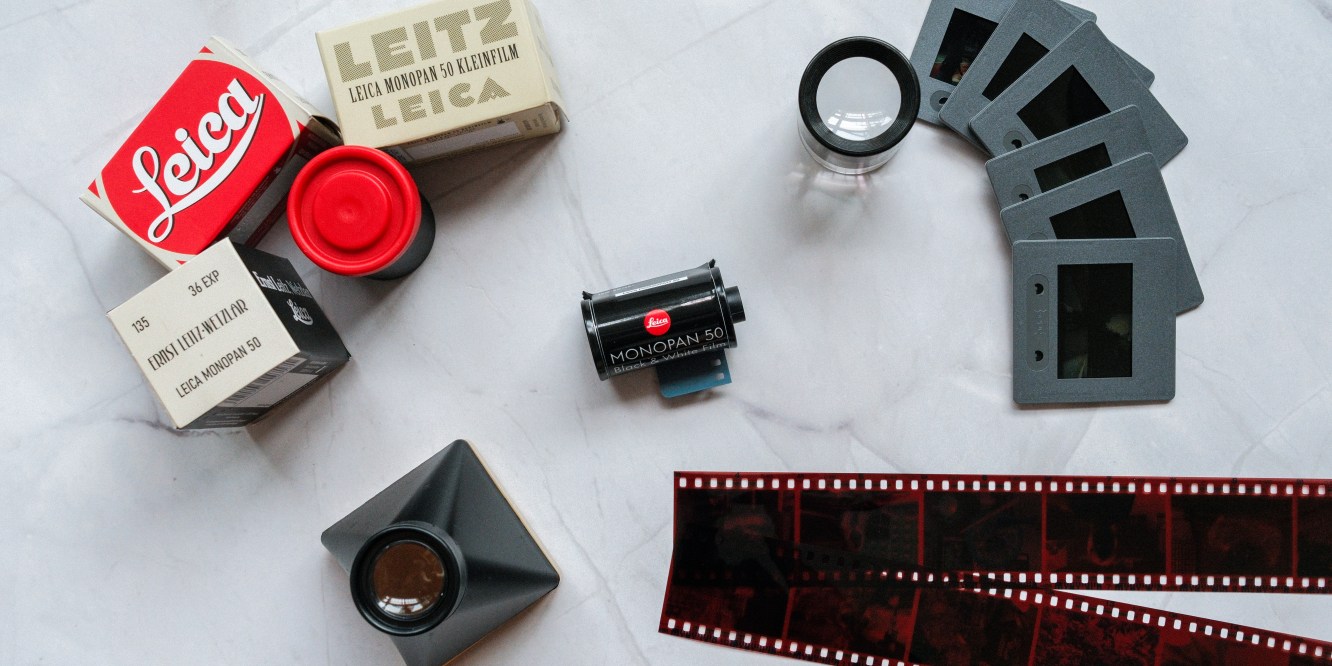
To mark the 100th anniversary of the original Leica I camera, Leica has released (according to them) a brand new black and white film. Named the Leica Monopan 50, this film is an ultra-fine grain, super-panchromatic black-and-white film that promises both technical excellence and creative flexibility.
Leica calls the Monopan 50 its first “true” black-and-white film.

*All scans shared here are from Leica Monopan 50 developed and scanned at a local developer. Being scans from films and my perspective as a reviewer, no retouching was done other than the usual cropping where necessary.
Technicalities (what matters)
Ultra-Fine Grain and Resolution
Leica has shared the Monopan 50 features an ultra-fine grain look, delivering a resolution of up to 280 line pairs per millimeter. This is designed to keep up with the resolving power of Leica’s optics, including its APO-Summicron series.
In comparison, while Monopan 50 achieves a resolution of 280 line pairs per mm, Kodak Tri-X 400 offers around 50 line pairs per mm.

Not mentioned enough is that there is no DX coding on Leica Monopan 50, this means that the photographer will need to manually set the film speed, if not the film camera (including DX-code capable ones) will default to the standard ISO100 or ISO200 depending on the model.


‘Super’ Panchromatic Sensitivity
What makes MONOPAN 50 stand out further is its spectral sensitivity that extends to 780 nanometers. Tech speak aside, this means Monopan 50 responds not only to the visible spectrum, but also into the near-infrared range.


Similar to what draws some people to Kodak Tri-X 400, this characteristics allows Monopan 50 to provide an exceptional tonal range. Photographers can even experiment with infrared landscapes, extending one’s creative exploration.

Not only for street photography, the Monopan 50’s characteristics lends itself suitable for also architecture and landscape.
the ISO 50 speed
A honest opinion would be that I would have preferred a more versatile ISO 400 or even ISO 100 versus the Monopan’s ISO 50. However this was Leica’s intentional decision to encourage working with wider apertures available using their super-fast Noctilux and Summilux lenses in daylight.


Derivation
There has been a fair share of skepticism, with some suggesting that Leica may have rebranded Adox HR-50, which coincidentally was discontinued about the same time of the Monopan 50’s announcement.

While I hear the conversations, I personally find Monopan 50 to be a distinctive emulsion in its own right. Monopan 50 is unique, though like many films, may have been derived from an existing stock such as Adox HR-50.
Output wise, I find Leica Monopan 50 a sharp, contrasty film with ‘hard ‘sudden breaks to a high white point. I do agree with Leica’s view that Monopan 50 works well for city-scapes, landscapes (the resolution) and portraits (the slow speed allowing fast lenses) and for both, the wide tonal range.


For portrait and even artistic renders where one works towards a contrasty black and white separation, Monopan 50 is appropriate even though that ISO 50 film is hardly as versatile as say, an ISO 400 film like StreetPan 400, Tri-X 400 or even Portra 400.
Conclusions
With Monopan 50, Leica is not just commemorating its centenary; it is making a statement that beyond continuing to produce film cameras, it is giving photographers a Leica-branded emulsion, engineered with the same intent as its optics: providing resolution, creative range, and a respect for tradition balanced with innovation.

For the film photographers who enjoy fine art printing, large-format enlargements, or high-resolution scanning, Monopan 50 looks set to deliver the crispness and tonal subtlety that make black-and-white film such an enduring medium across the 140 plus years since the 1880s.

Oh, I nearly forgot to mention that the Leica Monopan 50 is now also the most expensive 135 black and white film I know of at USD10 (or SGD20) per roll excluding development and scanning costs.
Thank you for reading.
Disclaimers:
- All product photos and samples here were photographed by me. I believe any reviewer with pride should produce their own product photos.
2. All images were shot with the Leica Monopan 50, paid out of my own pocket (including the development and scanning costs).
3. This review is not sponsored.
4. I write as a passion and a hobby, and I appreciate that photography brands are kind enough to respect and work with me.
5. The best way to support me is to share the review, or you can always help support me by contributing to my fees to WordPress for the domain using the Paypal button at the bottom of the page.

 KeithWee | Photography
This is same film with Adox HR50, now Adox 50 is almost out of stock, less cheaper than Leica brand.
LikeLike
Hi! That’s a very often heard comment. Credit where it’s due and I like that the Petapixel team did a very good comparison of Adox HR50 and Monopan 50 and I invite you to take a look at their review.
LikeLike
A well done review, Keith. It has been tough getting a roll of Monopan as most Leica stores I checked had no stocks.
LikeLike
Hi , thank you for dropping by 🙂 my guess as usual for Leica , stocks are quite limited for the first few weeks but I’m pretty sure more will be available soon. Hope you get one to try soon!
LikeLike
Great review as always
LikeLike
Hi, thank you for the kind words. 🙂
LikeLike
Very nice photos. May I know which camera and lens are you using?
LikeLike
Hi, thank you 🙏 I can’t share the camera body due to an NDA but the lens is a 35mm F2.8 full frame equivalent 🙂
LikeLike
Hi Keith do you know what developer was do your roll? The standard Kodak D-76 is not recommended based in the Leica data sheet and the only Kodak developer recommended is the XTOL.
LikeLike
Hi good day. I’m not sure as i had simply sent this in as a standard black and white roll of film and tbh i do feel that the developing could have been done better.
LikeLike
Where did you get the idea from that the Adox HR-50 is or has been discontinued? The film is and has been readily available almost contiously since its introduction.
Whether or not this Leica film is Adox HR-50, I won’t comment on… 😉
LikeLike
Hi, good point. Seems like Adox HR-50 is avail and that’s great news actually.
LikeLike