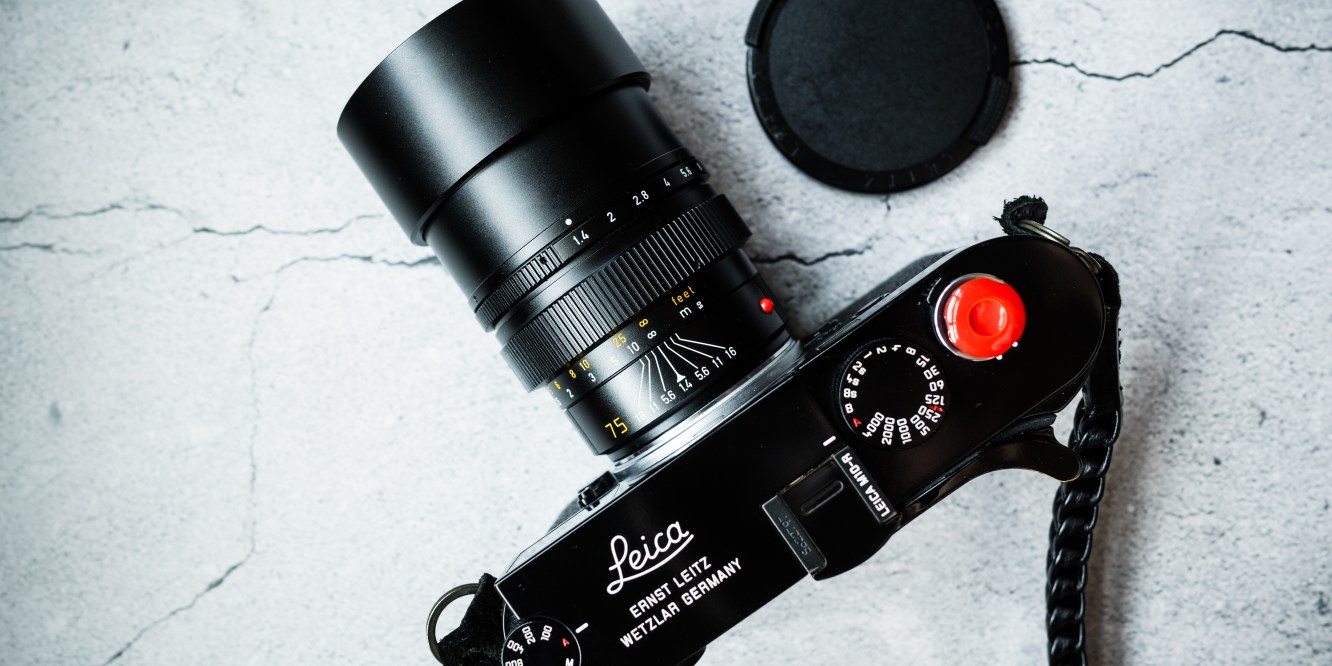
Introduction
There are lenses that make perfect sense on paper, and there are lenses that make perfect sense only after one has seen the photographs they produce.
The Leica Summilux-M 75mm ƒ1.4 v2 belongs firmly in the second category.

For many Leica M photographers, the 35mm and 50mm focal lengths are almost inseparable from the rangefinder experience. Those preferring a tighter perspective may venture towards the 90mm, leaving the 75mm occupying a somewhat awkward space in between.
In fact, I would venture to say that the 75mm is probably one of the less appreciated focal lengths in Leica’s M-mount ecosystem.
So what makes a discontinued lens, introduced more than four decades ago, with an unconventional focal length and considerable weight, worthy of attention today?

The answer lies in its rendering.
The Summilux-M 75mm ƒ1.4 was introduced in 1980, designed by the legendary Dr Walter Mandler, whose contributions to Leica’s optical history include the renowned Noctilux 50mm ƒ1 E58 (my review is here)

Interestingly, the 75mm Summilux is supposedly one of Mandler’s personal favourite designs, reportedly because of the balance he achieved between optical performance and physical dimensions.
For this review, I will be looking at Version 2 of the Summilux-M 75mm ƒ1.4, distinguished by its built-in retractable lens hood and built in Canada roots.
Despite the different focal lengths and maximum apertures, there is an unmistakable familiarity in how the two lenses draw an image.
The gentle transitions, beautiful subject separation, slightly dreamy rendering and the unmistakable character of Mandler’s optical designs are all part of the attraction.
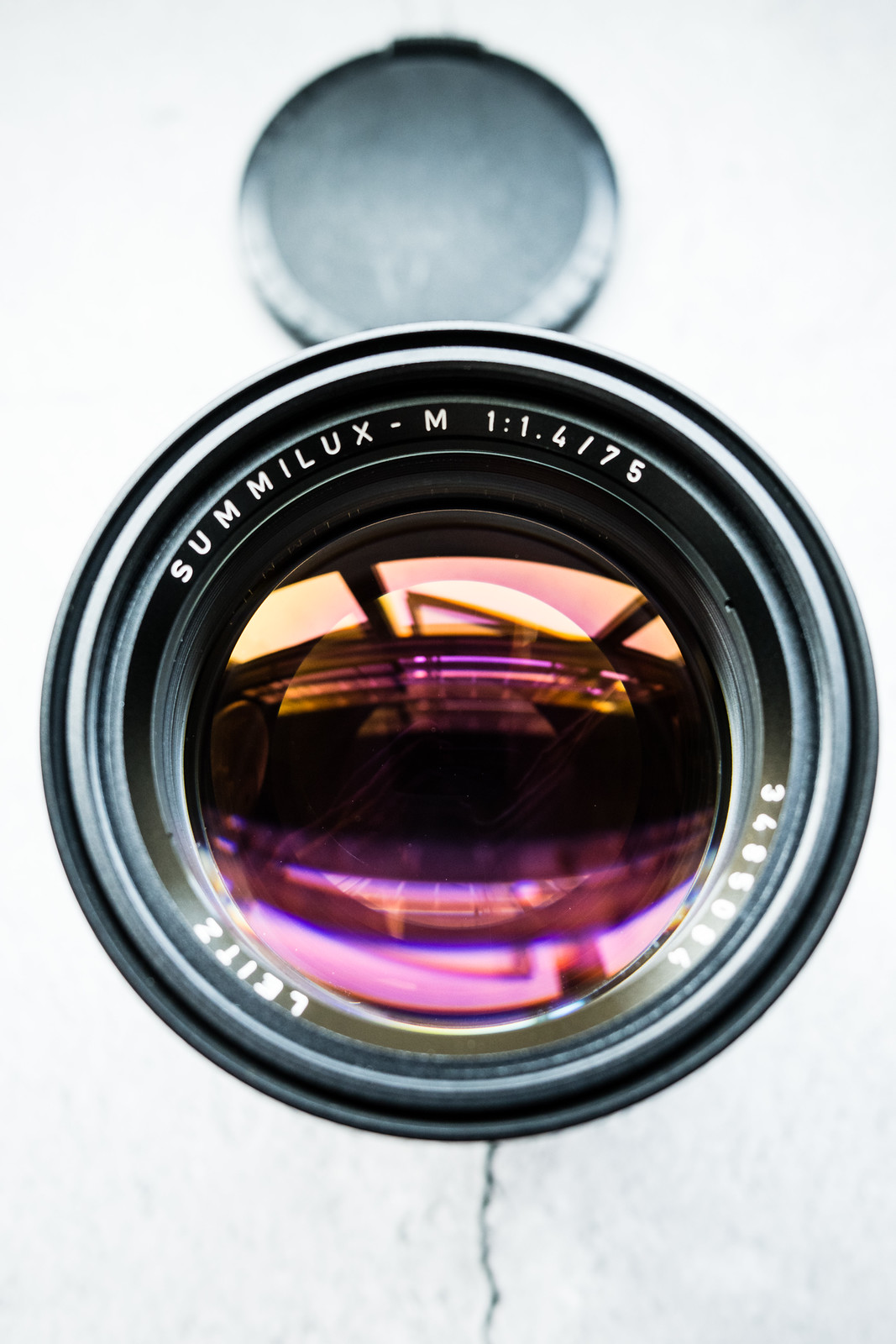
The Summilux 75mm ƒ1.4 is not simply another fast portrait lens. To me, it is an opportunity to rediscover an optical philosophy from an era when lenses were designed to produce beautiful photographs, rather than simply achieve impressive laboratory results.
Let’s take a deeper look.
tl;dr
The Leica Summilux-M 75mm ƒ1.4 is a lens that prioritises character over technical perfection, and one that rewards photographers who appreciate the subtleties of classical Leica rendering.
For photographers familiar with the Noctilux 50mm ƒ1 E58, there is something remarkably familiar about the images produced by this Summilux.
Wide open, the lens produces a combination of subject separation, gentle contrast, soft transitions and an almost painterly background rendering. The longer 75mm focal length further enhances this separation, producing portraits with a distinctive sense of depth.

It is not the smallest or lightest Leica M lens. Neither is it the easiest to focus accurately at ƒ1.4, especially on a rangefinder.
There are also optical imperfections, including chromatic aberrations, vignetting and susceptibility to flare, which remind us that this is a design originating from the 1980s.
However, those looking for clinical perfection are probably missing the point of this lens.
The 75mm Summilux is a lens one chooses not because it renders everything perfectly, but because of how beautifully it renders what matters.

Technicalities
Introduced in 1980, the Leica Summilux-M 75mm ƒ1.4 was one of Leica’s most ambitious fast short-telephoto lenses of its time. (There is a Noctilux-M 75mm ƒ1.25, I have never handled it).
Designed by Dr Walter Mandler, the lens employs a classical non-aspherical optical formula consisting of seven elements in five groups.
The lens remained in Leica’s catalogue until 2007, spanning almost three decades of production across three main versions.
The original Version 1, introduced in 1980, featured a detachable lens hood and a relatively lighter barrel. Version 2, introduced around 1982, incorporated a built-in retractable hood and revised mechanical construction, while the later Version 3 was predominantly manufactured in Germany.
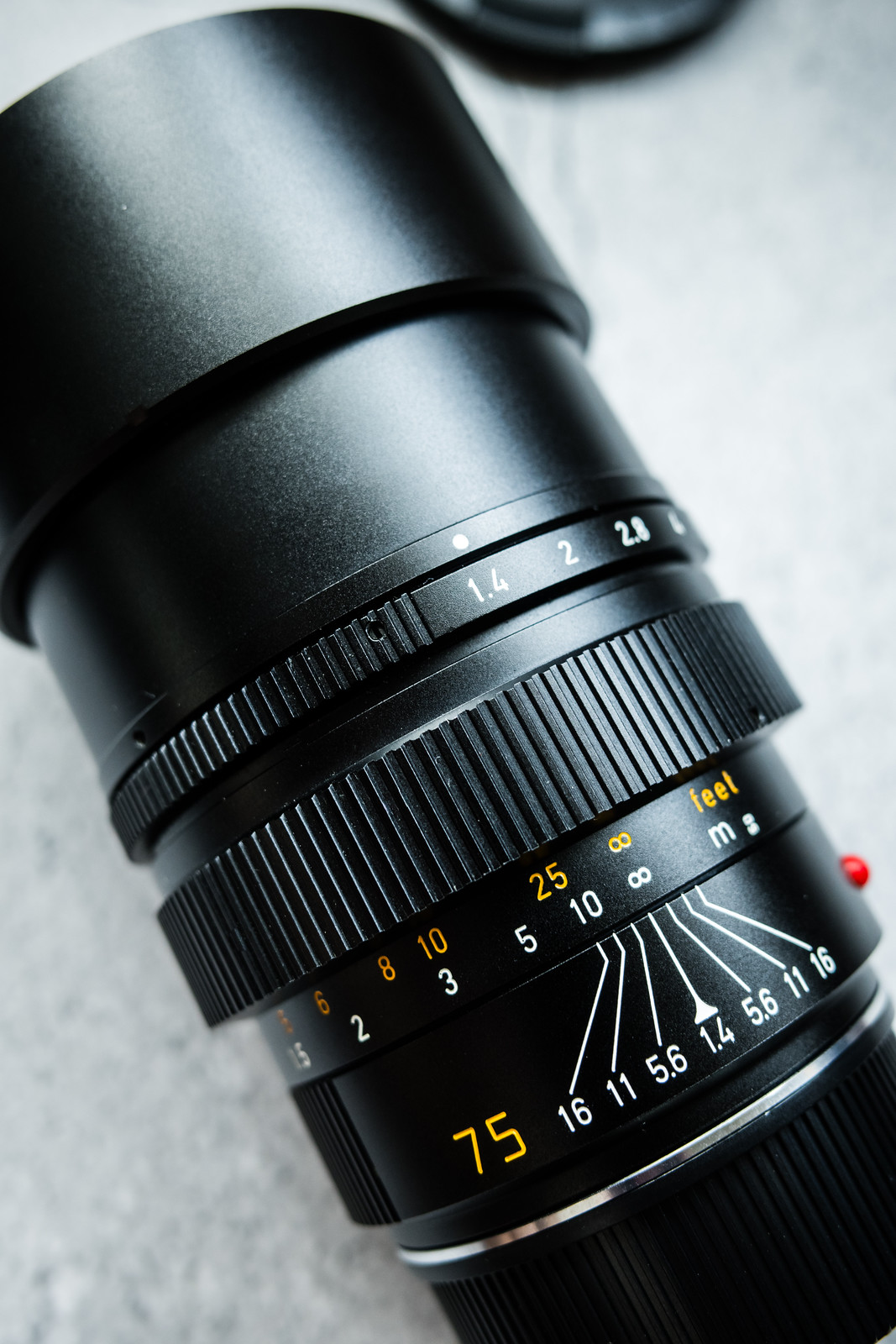
Importantly, the fundamental optical formula remained unchanged throughout these versions.
This means that unlike the many Leica lenses which have undergone substantial optical redesigns over successive generations, the 75mm Summilux retains the essential character of Mandler’s original design.
Version 2
- Focal length: 75mm
- Aperture: ƒ1.4 to ƒ16
- Optical design of 7 elements in 5 groups with 10 aperture blades
- Minimum focusing distance: Approximately 0.75m
- Filter size: E60
- Lens hood: Built-in, retractable
- Dimensions: Approximately 80mm (L) and 69mm (D)
- Weight: Approximately 600g
- Production period: Approximately 1982–1998 for Version 2, made in Canada
One important point worth highlighting is that the 75mm Summilux is not an modern aspherical design.

This is significant because much of its distinctive rendering can be attributed to how the classical optical formula balances sharpness, spherical aberrations and the transitions between areas of focus and defocus.
Modern aspherical lenses are often designed to minimise optical imperfections, delivering outstanding sharpness and contrast across the frame even at their largest apertures and Mandler’s 75mm Summilux comes from a different era of optical design.
It is capable of producing sharp images, particularly around the central portion of the frame, but the way it transitions into the out-of-focus areas is arguably the more important part of its character.

Handling
The first thing to appreciate about the Summilux-M 75mm ƒ1.4 is that this is not a small lens.
At approximately 600 grams, it is substantial by Leica M standards, particularly when compared with the compact 35mm and 50mm lenses most rangefinder users like us are accustomed to.

Mounted on an Leica M body, the lens introduces a distinctly front-heavy combination, and its large front element is impossible to ignore, similar to when one is using the Noctilux-M 50mm ƒ0.95 (my review is here)
However, there is something quite reassuring about the solid metal construction, beautifully damped manual focusing mechanism and tactile aperture ring reflect the mechanical craftsmanship that Leica has long been associated with.
The built-in retractable lens hood of Version 2 is another welcome improvement over the original design, removing the need to carry a bulky separate hood.
Of course, the large barrel inevitably introduces some obstruction into the rangefinder’s viewfinder, and this is something one has to accept. The longer focusing throw also makes the lens better suited to deliberate photography than rapid snapshots, and it is important to note that this lens is not meant for a snapshooter.
Like several other fast Leica lenses of its generation, the 75mm Summilux can exhibit focus shift, and it is good to check calibration.
For those using an M camera with live view or the Visoflex, magnified focusing can be particularly useful.
Image Quality and Rendering — Mandler’s Other Noctilux
The 75mm focal length has always occupied a somewhat unusual position in Leica’s M system. For photographers accustomed to 35mm or 50mm lenses, it can initially feel restrictive, offering less room for environmental context. However, for portraiture, the tighter framing allows one to isolate the subject more effectively, without requiring the working distance of a 90mm lens.
Now, to what I find most interesting about this lens: its rendering.

Readers familiar with my reviews will know of my soft spot for the original Leica Noctilux 50mm ƒ1 E58, particularly its distinctive combination of gentle contrast, beautiful transitions and what some refer to as the Mandler Glow.
Interestingly, the Summilux 75mm ƒ1.4 reminds me very much of the E58 Noctilux. While the focal lengths and perspectives are different, there is a familiar quality to how both lenses render light and the transitions between areas of focus and defocus.

Wide open at ƒ1.4, the Summilux delivers sufficient sharpness to define the subject, accompanied by a gentle softness that can be particularly flattering for portraits. Backgrounds melt away beautifully, giving images an almost painterly quality, with subjects appearing to emerge naturally from their surroundings rather than being abruptly separated from them.
Skin textures are rendered with sufficient detail without appearing overly clinical, while the slightly lower contrast gives portraits an organic, almost timeless quality. It is an aesthetic that I have always appreciated with the Noctilux E58, and one that I am pleasantly surprised to find in the 75mm Summilux.


Naturally, a lens designed more than four decades ago comes with its share of compromises. Chromatic aberrations, vignetting and susceptibility to flare are all present, particularly at wider apertures and should not expect edge-to-edge sharpness at ƒ1.4.

After all, the Noctilux E58 is hardly a technically perfect lens by today’s standards, yet it remains one of my favourites precisely because of how it renders an image.
The Summilux 75mm ƒ1.4 follows very much in the same tradition.
Conclusions
The Leica Summilux-M 75mm ƒ1.4 is not an easy lens to recommend universally and more of a specialised piece of optics.
From a purely technical perspective, modern alternatives such as the APO-Summicron-M 75mm ƒ2 ASPH offer significantly improved optical correction in a smaller package or even the modern Noctilux-M 75mm ƒ1.25 ASPH (probably) takes the concept of a fast portrait lens to an entirely different level of optical performance.
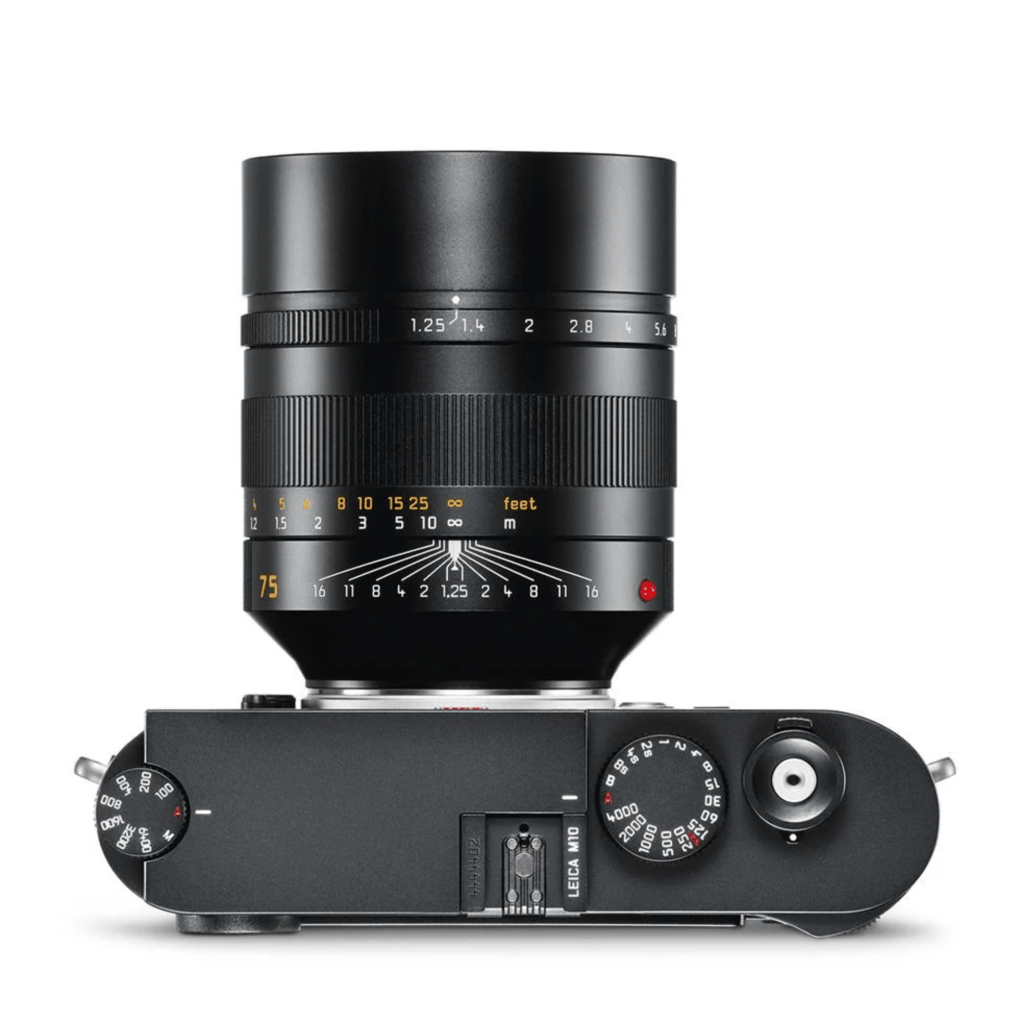
Image Source: Leica Store
Yet, I would argue that neither comparison fully explains the appeal of the original Summilux.
The Summilux-M 75mm ƒ1.4 was never about achieving technical perfection according to contemporary standards. Instead, it represents a particular period in Leica’s optical history, when the rendering characteristics of a lens could be as important as its resolving power.

And this is where the association with Dr Walter Mandler becomes especially meaningful.
Both lenses offer a distinctive combination of gentle rendering, subject separation and beautiful transitions, with an unmistakable character that is increasingly difficult to find among modern, highly corrected optics.
The Summilux-M 75mm ƒ1.4 may not be the most practical Leica lens to own, but it is certainly one of those lenses that can remind us why we fell in love with photography in the first place.
After all, a technically perfect photograph is not necessarily a beautiful one.
Thank you for reading.
Disclaimers:
1. All product photos and samples here were photographed by me. I believe any reviewer with pride should produce their own product photos.
2. All images were shot with a loan set of the Summilux-M 75mm ƒ1.4 on my M10-R.
3. This review is not sponsored and the Summilux-M 75mm ƒ1.4 returned at the end of the review.
4. I write as a passion and a hobby, and I appreciate that photography brands are kind enough to respect and work with me.
5. The best way to support me is to share the review, or you can always help support me by contributing to my fees to WordPress for the domain using the Paypal button at the bottom of the page.


One Reply to “Leica Summilux-M 75mm F1.4 v2 Review: Mandler’s Other Noctilux”