The story
September brought an opportunity for six days in Hangzhou as part of a work-related learning journey. Travelling with fellow educators, our itinerary brought together school visits, technology companies and opportunities to understand a little more of the city beyond the mundane meeting rooms.
And, of course, a camera was coming along.
This time, it was the Leica Q2.

Travelling for work gives photography a slightly different rhythm in that I can’t really have the freedom to roam anywhere I wanted to. There are places to be, timings to keep and a group which will not wait for me simply because the “light is beautiful”.

And so, the moments I captured have to happen somewhere in between.
This photo essay today follows my journey through Hangzhou for 6 days in September, with a little more attention given to the everyday city around the official programme.
The gear
For this trip, bringing the Leica Q2 was a deliberate choice. Released in 2019, the Q2 is now seven years old. With newer cameras constantly arriving, I wanted to take it along and show that it remains a capable tool for documenting a journey.
The Leica Q2 pairs a 47.3-megapixel full-frame sensor with a Summilux 28mm ƒ1.7 lens. It is a straightforward combination for this sort of trip: a wide view for keeping people within their surroundings, and enough resolution for some cropping when needed.

As someone who reviews cameras regularly, I can appreciate what each new generation brings. But spending time with newer equipment also makes it worth revisiting what we already have. The arrival of a successor does not make the photographs from an older camera any less worthwhile.
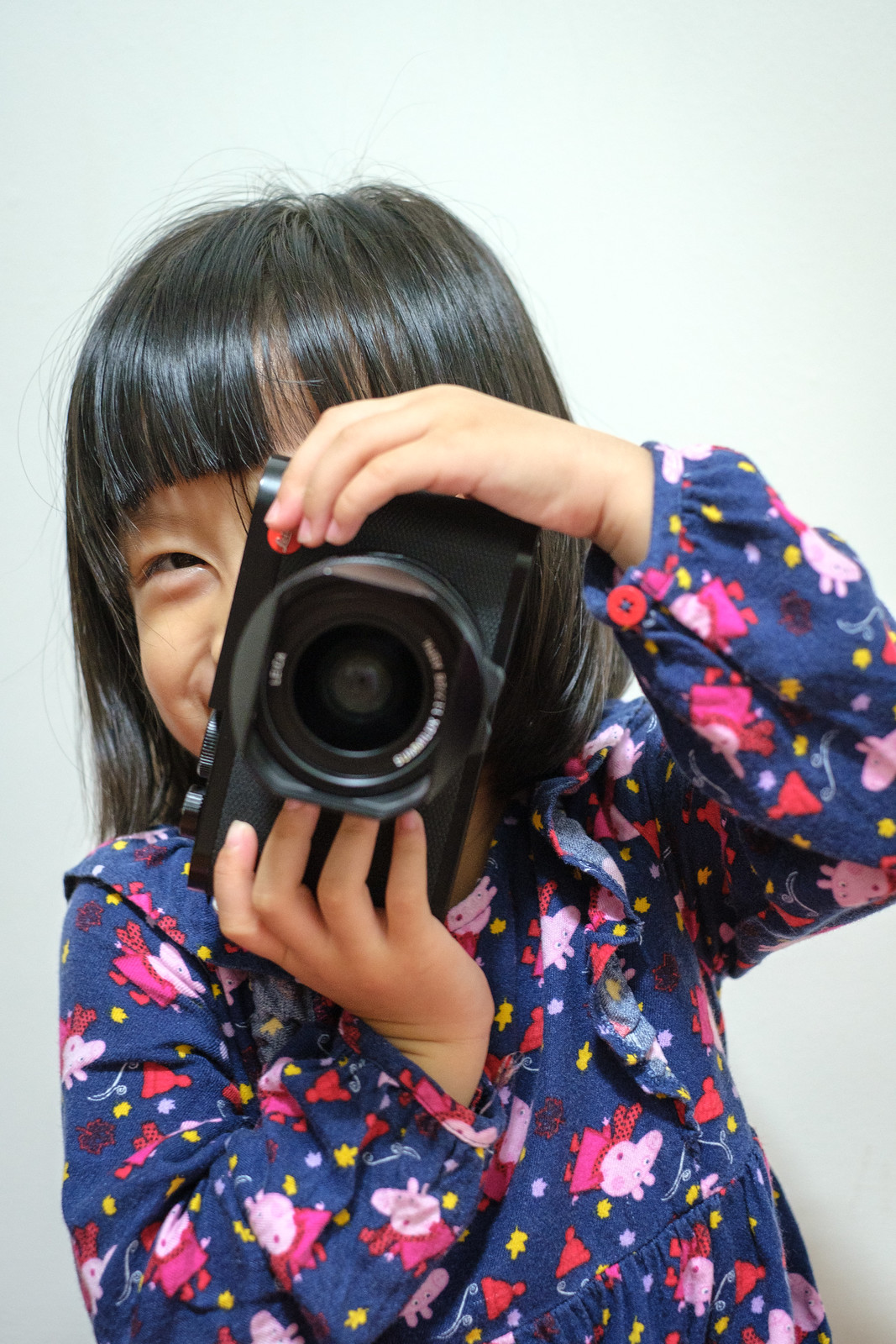
A person’s expression matters, but so does the shop behind them, the space they occupy and whatever happens to be entering the edge of the frame. Sometimes these details make the photograph. Sometimes they make a mess of it.
That is also part of the challenge.
With a fixed lens, the decision becomes where to stand, when to move closer and when to let a scene go. For a trip with a fairly full programme, I appreciate having fewer equipment decisions to make.
Arriving in Hangzhou
Our journey began with arrival in Hangzhou scheduled for the evening. From the airport, we headed to our accomodation on Zhonghe North Road, our base for the week.

Our accomodation was actually quite near Hangzhou’s famed West Lake, more on this later.
Unexpectedly, there was something quite enjoyable about arriving somewhere after dark. You have an address and a room for the night, but very little sense yet of the streets around you.
I was raring to check out the everyday streets a few hours later.
Around the hotel
Exploring the neighbourhood around our hotel on the pretext of grabbing coffee gave me space to follow my own curiosity.
There was no need to make every walk into a full blown photo-walk. A few streets can be quite enough with a camera in hand and well, 30 minutes per round.
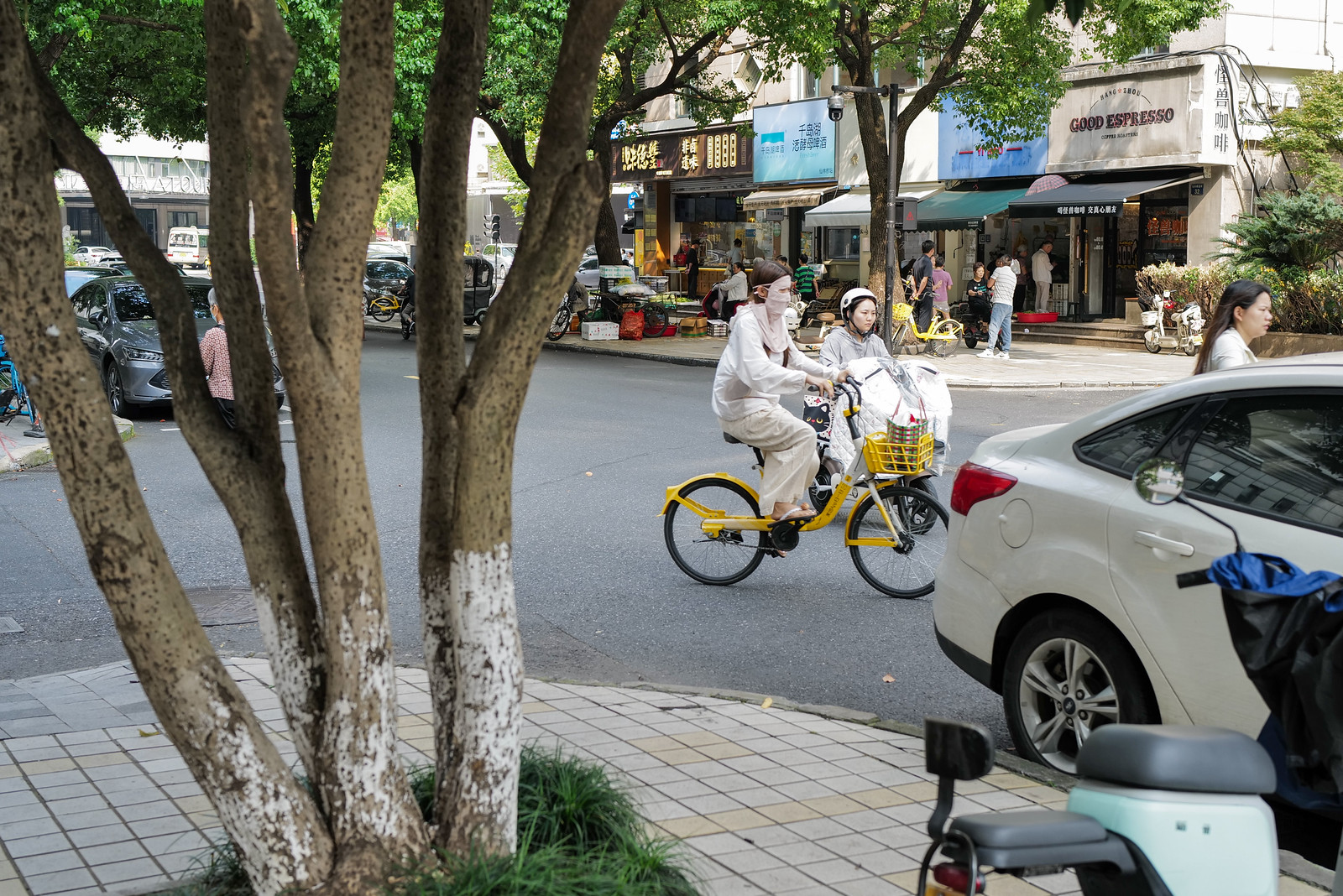


These are the places where I enjoy looking for photographs: the edges of shops, the junction between a busy road and a quieter lane, and the small spaces where people pause before continuing with their day.
The appeal is in how ordinary and yet full of stories every scene is.
As a visitor, I have the luxury of finding something interesting in a place someone else passes through every morning. It is a useful reminder that what feels familiar to us may be worth another look too.


With the Q2, I wanted to keep that sense of place in the frame. Moving too close can remove the surroundings that first caught my attention; staying too far away can leave the photograph without a clear subject.

And yes, “a short walk around the hotel” is a rather flexible description when a camera is involved.

Another thing I noticed here vs Singapore is how much more competitive and more efficient food delivery services are in Hangzhou. Our local company, Grab even with their monopolistic hold in the Singapore market will not likely survive here.

Gongchen Bridge and the Grand Canal
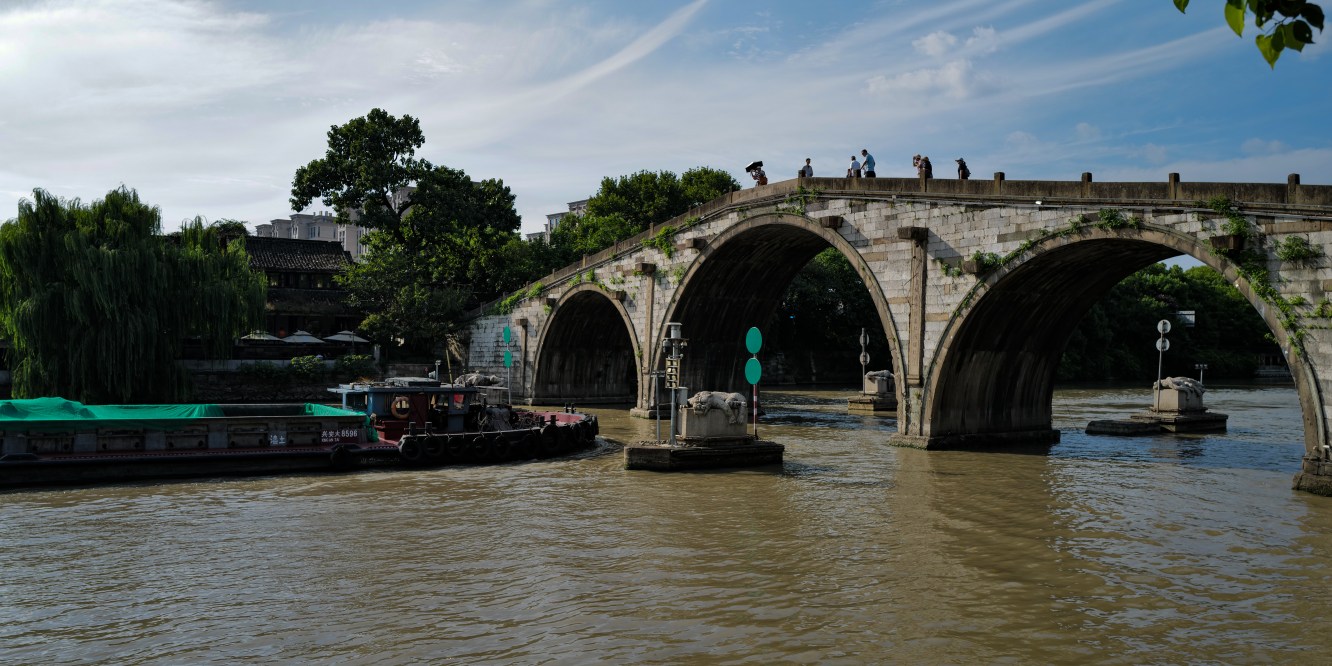
Early in the week, our itinerary took us to Gongchen Bridge and the Beijing–Hangzhou Grand Canal.

Both spots actually have a very deep and interesting history stretching across dynasties, and I will recommend you read up about them if you have the time.
It offered a change of pace from the formal visits, and a chance to spend time looking at the city from a different setting.

At a recognisable location, I usually want the wider photograph first. It establishes where I am and gives the rest of the images somewhere to belong.

After that, my attention tends to move towards the details.

A landmark gives a photograph its location. The way people use the space gives me a reason to keep looking and it was also interesting to see how the locals have kept the soul of the area mostly intact by thoughtfully planning the use of land around these two heritage landmarks across cultural, religion and shop purposes.


And of course, not forgetting the many cafes and souvenier shops dotting the length of the Grand Canal.


The learning visits

The middle of the week brought together visits to schools and organisations working across robotics, digital technology, research and everyday product innovation. For an educator, the programme offered plenty to consider about what young people will need as these technologies become more deeply embedded in their lives.


The school visits brought those larger questions back to teaching, relationships and the experiences we create for students. Technology was a recurring theme, but so were culture, values and the role of teachers. These are questions that stay with us well beyond an overseas visit.


Joyoung is in many ways like the Dyson of China, innovating and in over-engineering many solutions to our daily experiences.

One example that stayed with me was Chunhui Primary School’s indigo-dyeing project, where traditional craft provided a way into thinking about culture, sustainability and purposeful uses of technology. There was something meaningful in seeing attention given both to what is emerging and to knowledge worth carrying forward.


Also, data management is serious business in China, even in a school – the depth and breadth of data management will easily shame most other self-proclaimed front runner countries.

Above is a library in a Primary School in Hangzhou. It left me quite in awe of the sheer amount of resources and is testemant of how seriously education is taken in China.
Xian Lin Yuan Farmer’s Market
Alongside the scheduled visits, I also explored Xian Lin Yuan Farmer’s Market.
A wet market is the sort of place I am naturally drawn to with a camera. There is a reason for people to be there, things that need doing and a rhythm that continues whether anyone is photographing it or not.

What interests me is the interaction around the produce as much as the produce itself: hands at work, the distance between a customer and a stallholder, or a brief expression in the middle of a transaction.

And the thing is, a love for local wet markets is also because one never knows what one might find.


For this kind of photography, the Q2’s wider field of view offers an opportunity to bring several elements together. The person, the stall and the surrounding activity all comes together to form a story.

The red characters on the window means: “Fair Balance”, an office for settling disputes if someone’s weighing scale is in doubt.
Markets can be visually busy, and including everything rarely means saying more. Sometimes a small change in position is enough to give a gesture room to stand out.

Of course it just took a short while before some of the stall owners showed some displeaure in being photographed. Some moments are worth watching without lifting the camera.
West Lake and the surrounding shopping district
Towards the end of the week, the programme brought us to West Lake.


After several days of visits and conversations, this was an opportunity to give more attention to the surroundings and let the photographs take their time.
It is easily 15 years since I last visited the West Lake and I was quite taken aback how just next to it is now a bustling shopping avenue with international names.


I do not think every photograph needs to discover an angle nobody has ever seen before.

Sometimes you simply want to remember being there.
Hefang Street, and the last part of the journey
Hefang Street was another stop towards the end of our itinerary, giving the final stretch of the trip a different setting from the lake.

In a place with plenty competing for attention, I find it useful to slow down. There is a temptation to photograph everything simply because it is unfamiliar but then I really wanted to just slow down and take a chill pill at this point.
Instead, I try to look for a relationship within the scene: someone against a shopfront, a gesture amid the activity, or a small detail that says more than a much wider view.

15 years ago, I made a seal carving for myself and this round, a bunch of seal carvings for my wife, kids and haha, a few good friends. Of course, one can readily buy machine cut ones in Singapore but I will always prefer something hand-made and the craft behind it.


Our early departure on the next day brought the trip to a close. Six days sounds reasonably generous until you account for travelling and a full programme. The available time for photography passes rather quickly.
Conclusions
Looking back, the photographs I want from a journey like this are the ones that help me remember more than the names of the places we visited.

I want to remember what caught my attention along the way.
The hotel neighbourhood and Xian Lin Yuan Farmer’s Market belong in that story alongside Gongchen Bridge, West Lake and Hefang Street. Each offers a different way of looking at Hangzhou, and each gives the photographs something the others cannot.

The Leica Q2 gave this diary a consistent starting point: one camera and a familiar wide view. Within that frame, there was still plenty to work out, and plenty to notice. Seven years on, the Q2 still gives me plenty to work with. The challenge remains noticing something worth photographing.
That is what keeps travel photography enjoyable for me.
Thank you for reading.
Disclaimers:
- I photographed all product photos and samples here. I believe any reviewer with pride should produce their own product photos.
- All images were shot with the Leica Q2.
- This sharing is not sponsored. I write as a passion and a hobby.
- The best way to support me is to share the article, or you can always help to support the site by contributing to my WordPress subscription fees using the Paypal button at the bottom of the page.


One Reply to “Hangzhou, Between the Scheduled Stops: A Street Diary with the Leica Q2”