Introduction
There are lenses which are designed to remove character, and then there are lenses which exist because of character.
my review of the DK-Optic Chiaro 3-inch (76mm) ƒ1.9 is here. You can purchase DK-Optics lenses here or send a message to RKenix Creative Studio here.
The DK-Optic Impastolite 2-inch (51mm) ƒ1.5 belongs very much to the second category. At a time where 50mm M-mount users are spoilt for choice, from modern APO-corrected designs to classic Summilux and Sonnar-inspired options, DK-Optic has chosen a rather different path: resurrecting the spirit of one of the most mythical British fast lenses, the Dallmeyer Septac Anastigmat 50mm ƒ1.5.

For brevity’s sake, I will refer to the DK-Optic Impastolite 2-inch (51mm) ƒ1.5 M simply as the DK-Optic Impastolite from this point onwards.
The original Septac occupies that very special space amongst collectors. It was never famous because it produced technically perfect files by modern standards. Rather, it became desirable because of its glow, melting highlights, swirly bokeh, and that almost oil-painting-like transition from subject to background.

DK-Optic’s stated intention with the Impastolite is clear. This is not a modern fast fifty pretending to be vintage through exterior styling alone. It is presented as an authentic optical recreation, built with modern mechanical precision but deliberately avoiding the clinical correction that would erase the very charm one would want from such a lens.

And that makes the Impastolite interesting.

Let us take a deeper look.
tl:dr
The DK-Optic Impastolite is a 51mm ƒ1.5 Leica M-mount lens inspired by the legendary Dallmeyer Septac Anastigmat 50mm ƒ1.5, one of those rare vintage lenses spoken about with almost mythical reverence among collectors and character-lens users.
It uses a 7-elements-in-5-groups optical design, covers full-frame 135 format, focuses down to 0.7m, and features an 18-bladed aperture. At only 179g, it is surprisingly light for a fast ƒ1.5 M-mount lens, especially considering its brass and aluminium hybrid construction.
This is not a lens for photographers looking for technical neutrality. The DK-Optic Impastolite is for photographers who want glow, swirl, flare, fall-off, and a rendering that leans closer to painting than measurement.
Wide open at ƒ1.5, the stated promise is not modern sharpness across the frame, but ‘atmosphere’ (in DK-Optic’s words). DK-Optic describes the lens as producing glow, painterly swirly bokeh, and cascading “peacock feather” flares when used against backlight. Stopped down, the image is said to gain contrast and resolving power quickly, giving the lens a useful dual personality.

To me, that is the whole point of such a lens.
A modern Summilux, Voigtländer Nokton, or Zeiss Planar will give one a cleaner and more predictable 50mm experience. The DK-Optic Impastolite is not interested in this race. It is instead offering a very specific visual signature for portraits, still life, slower documentary work, and photographs where mood matters as much as detail.

At USD $1,999, it is not inexpensive. However, when seen against the rarity (as of writing this review, I can only find one available set and the asking is USD36,000) and almost unreachable price of an original Septac, the Impastolite becomes a more realistic way of experiencing that style of rendering in a native Leica M-mount body.
This lens will appeal most to photographers who already know why they want it and that is probably how it should be.
Technicalities
The DK-Optic Impastolite follows the same broad philosophy seen in DK-Optic’s other vintage-inspired lenses: recreate the soul of a historical optical design, but house it within a body that feels usable on a modern Leica M.

The key specifications are as follows:
- Focal length: 51mm / 2-inch
- Aperture: ƒ1.5 to ƒ11
- Format coverage: 135 full-frame for Leica M-mount
- Optical design: 7 elements in 5 groups
- Minimum focusing distance: 0.7m, rangefinder-coupled
- Aperture control: Manual preset, dampened and calibrated to cinema-grade standards
- Aperture blades: 18 blades
- Filter thread: 43mm on lens body / 46mm on lens hood (I install the UV filter between the lens and hood)
- Length mounted on camera: 46mm
- Maximum diameter: 54mm
- Weight: 179g, excluding caps
- Construction: 7075 aerospace-grade aluminium exterior with CNC-machined brass focusing and aperture mechanics
The 18-bladed aperture is another interesting point. For a lens whose identity is so closely tied to out-of-focus rendering, maintaining rounder highlights matters.
A notable detail is DK-Optic’s choice of materials. The exterior barrel uses 7075 aerospace-grade aluminium to keep weight down, while the focusing helicoid and aperture mechanics use CNC-machined brass. On paper, this makes sense. It keeps the lens portable while retaining the smoother, denser mechanical feel that one expects from a premium manual-focus optic.

DK-Optic also mentions the use of decades-old New Old Stock optical glass, together with a vintage-style amber coating. Whether one sees this as romantic storytelling or meaningful optical archaeology, it does fit the lens’s intended identity.

Handling & Performance
I will be upfront, the DK-Optic Impastolite was surprisingly light when I first held it, and for photographers who associate heft with quality, this will be an eye-opener.
At 46mm in length when mounted and 54mm in diameter, the lens sits in that comfortable zone for Leica M bodies: large enough to feel purposeful, but not so large that it overwhelms the camera. The 179g weight is especially welcome in keeping the kit compact.

Mounted on a Leica M body, this should make the Impastolite feel closer to a daily-use character lens rather than a special-occasion novelty. That is important because the real test of such lenses is not whether they look beautiful on a shelf, but whether one actually wants to use them.
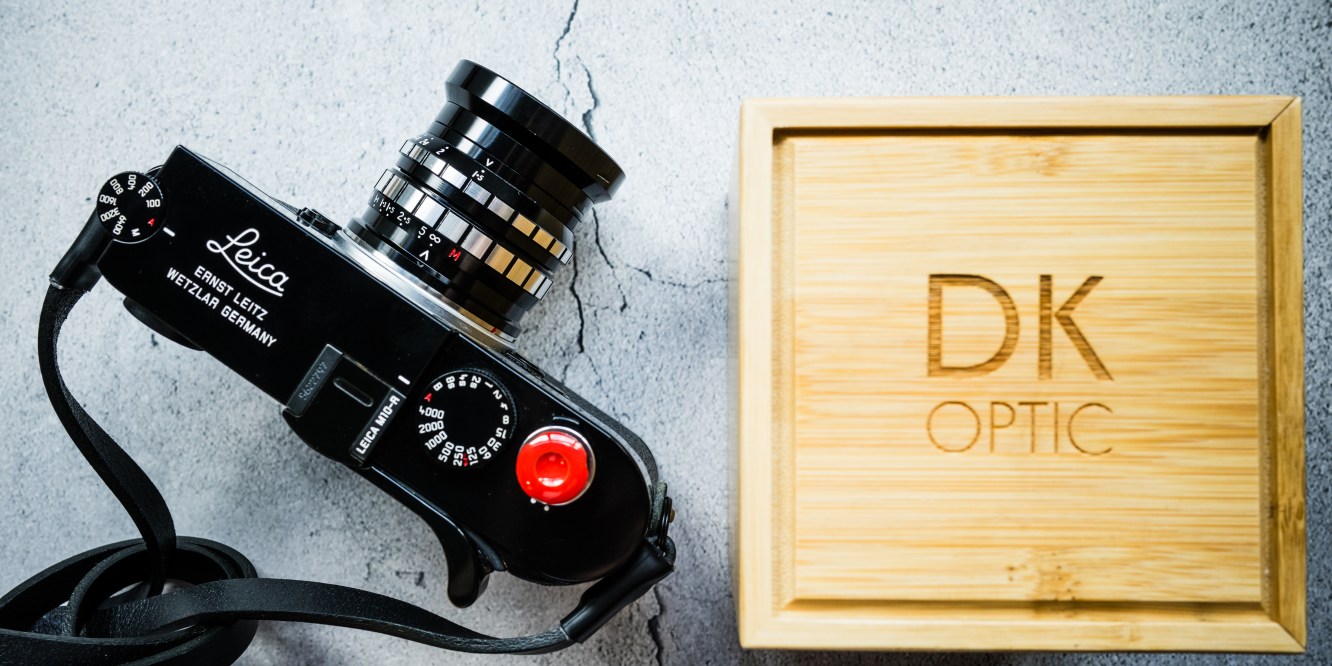
The black paint finish gives the lens a very appealing visual presence on my glossy black paint Leica M10-R body ; on a silver body, it would probably provide a nice contrast.

The detachable threaded metal hood is also a welcome inclusion. With a lens of this design intent, flare is not necessarily something to eliminate entirely. In fact, some buyers will likely want the flare. However, having the hood gives the photographer a choice, and choice matters when working with character optics.

The aperture ring is well dampened and calibrated to cinema-grade standards. This is an interesting choice. It suggests that DK-Optic is drawing from its cinema lens production background rather than simply building a stills lens. For photography use, some may miss the certainty of clicked aperture settings. For video users, or photographers who enjoy smoother aperture transitions, the dampened movement will be useful.

The focus throw and tactile resistance will matter a lot here. A ƒ1.5 rangefinder-coupled lens at 0.7m demands precision, especially if one is using it for portraits. At close distance, the plane of focus will be thin, and this is not the type of lens one should rush, and the DK-Optic Impastolite is a lens which you will want to mostly photograph at maximum aperture.


Optically, the Impastolite should not be approached like a modern APO 50mm lens. Wide open at ƒ1.5, the intention is glow, separation, swirl, and a softer, more atmospheric transition into blur. Used in the right conditions, this can be beautiful. Used carelessly, the output can also become messy.
And this is the honest part about lenses with strong character: they are not obedient in every situation.
Backlight will likely bring out flare and halation. Busy backgrounds may swirl more noticeably. Highlights may melt in ways that modern lens designers are usually paid to suppress. Some photographers will see these as flaws. Others will see them as the entire reason to own the lens.

Personally, I find this far more interesting than yet another technically competent 50mm.
Stopped down, the Impastolite becomes more controlled. Both contrast and resolving power build quickly as the aperture is stopped down, and this is exactly the kind of dual behaviour one hopes for in a lens like this. Romantic at ƒ1.5, more disciplined from around ƒ2.8 to ƒ4, and sufficiently practical when one needs a cleaner image.


Personally I am most fond of this lens at ƒ2 and will go to at ƒ1.5 when I really want the most characterful shot.


This makes the lens more versatile than it may first appear. It is not only for dreamy portraits. It could be used for travel details, still life, environmental portraits, quiet street scenes, café interiors, and those small family moments where a modern clinical rendering may feel too plain.
And of course, for those who might want to know, stop down enough and the DK-Optic Impastolite can be quite a ‘normal’ lens, though one can still see elements of the painterly character in the output.

Conclusions
The DK-Optic Impastolite 2-inch (51mm) ƒ1.5 M is one of those lenses that makes sense only when one stops asking the wrong questions.
The wrong question is whether it is sharper, cleaner, or more corrected than the best modern 50mm lenses for it will never be. Attempts to post process shots from it to be more clinically correct is well, misunderstanding the raison d’être of this lens.

The better question is whether it offers a rendering that feels meaningfully different.
And on paper, DK-Optic seems to understand exactly what it is trying to recreate: the glow, swirl, painterly blur, flare behaviour, and vintage tonal personality that made the Dallmeyer Septac such a desirable in the first place.
The DK-Optic Impastolite is not about optical perfection. It is about choosing imperfection with intent.
That is why this lens is interesting. It is not merely a nostalgic-looking 50mm with a fast aperture. It is a deliberate attempt to bring a rare and historically charismatic optical signature into a modern Leica M-mount workflow.

The DK-Optic Impastolite is for the photographer who already owns a sensible 50mm and wants something less sensible. It is for the photographer who enjoys the way old glass bends light, who sees flare not merely as a defect, and who values emotional rendering over optical obedience.
It is probably not a lens I would recommend as someone’s only 50mm but as a second or third 50mm for a Leica M user who knows what he or she is looking for, the Impastolite becomes far more compelling. It offers a rare visual language without the fragility, scarcity, and collector-level pricing of the original Dallmeyer Septac

In a market increasingly filled with lenses chasing technical sameness, the DK-Optic Impastolite chooses to be opinionated, and unique enough to attract only those who know how to appreciate it.
my review of the DK-Optic Chiaro 3-inch (76mm) ƒ1.9 is here. You can purchase DK-Optics lenses here or send a message to RKenix Creative Studio here.
Thank you for reading.
Disclaimers:
1. All product photos and samples here were photographed by me. I believe any reviewer with pride should produce their own product photos.
2. All images were shot with the DK-Optic Impastolite 2-inch (51mm) ƒ1.5 on the Leica M10-R.
3. This review is not sponsored. Just in case, the purchase links shared are out of my goodwill, and I do not earn anything when you make a purchase through them.
4. I write as a passion and a hobby, and I appreciate that photography brands are kind enough to respect and work with me.
5. The best way to support me is to share the review, or you can always help support me by contributing to my fees to WordPress for the domain using the Paypal button at the bottom of the page.

 KeithWee | Photography
An extraordinary review, I am glad to see you reviewing this interesting lens.
LikeLike
Hi there, thank you for the kind words. I’m also glad to have an opportunity to share on this lens too. I realized reviews of this lens are hard to find too.
LikeLike
Beautiful picture shared and they do remind me of the Dallmeyer.
LikeLike
Thank you, I am quite glad to see DK-Optics doing a close to original rendition instead of a too-modernised remake too.
LikeLike