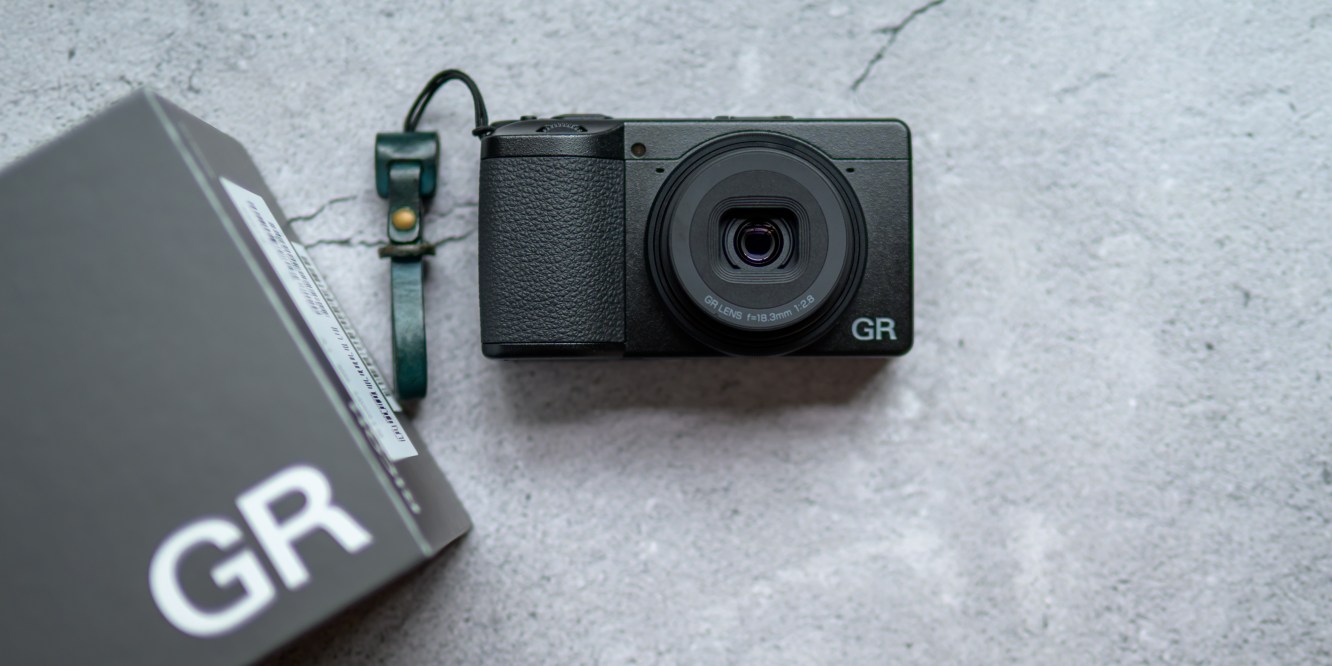
The essence of the Ricoh GR and what’s new
For someone who started with the Ricoh GR 1v film camera (my review is here), there is a kind of quiet honesty I’ve always loved about the Ricoh GR line: a camera that disappears in the palm, yet returns with images that generally exceeds my expectations for a body this compact, and on good days, even poetic.

With the Ricoh GR’s design already honed across the generations, the Ricoh GR IV doesn’t try to be clever for the sake of it. Instead, Ricoh trims the body even thinner, keeps that glove-like grip, and doubles down on the refinements: a new 26 megapixels APS-C sensor, a redesigned 28 mm equivalent ƒ2.8 lens, improved 5-axis image stabilisation, faster startup and more reliable and improved autofocus plus a few meaningful touches that speak to real street use rather than spec sheet vanity.

Ricoh also did some work at long-standing pain points: improved dust sealing around the lens assembly, a bigger battery, and surprisingly, a 53 GB of internal memory plus a microSD slot.
All this improvements and yet at the same time ensuing that the Ricoh GR IV stays truly pocketable and in fact, the thinnest Ricoh GR camera yet.
Let’s take a deeper look.
if keen, some of my GR reviews are here: Ricoh GR IIIx HDF, the GR IIIx, and GR III

tl:dr
The GR IV gets the fundamentals right for a successor model: the new lens design improves image quality, especially at the corners, the improved image stabilisation gets one steadier handhelds, and both autofocus and startup are snappier.

That built-in 53 GB storage is a genuine “forgot-your-card” safety net, while the ergonomics feel reassuringly old-school GR, now with dual command dials and a useful Snap-Distance Priority right on the mode dial. Caveats remain: subject-tracking autofocus still has room for improvement, making single-point/zone or Snap options the reliable choices for decisive moments, and although battery life has improved, it is not ground breaking.

I had hoped for weather-sealing which did not happen, but Ricoh worked on improved dust sealing for the lens element.
In short, the Ricoh GR IV is for photographers who prize stealth, speed and a transparent tool over bells and whistles; if you live at 28 mm and shoot from the hip, this is the most refined GR to date.
Technicalities and Handling
- 25.7 Megapixels CMOS APS-C sensor with updated imaging engine; native ISO up to 204,800.
- 18.3 mm ƒ2.8 (28 mm equivalent) with a new optical formula.
- In-body 5-axis image stabilisation
- Hybrid autofocus system with improved speed; new Snap Distance Priority mode on the dial.
- Storage: 53 GB internal + microSD (UHS-I).
- Dimensions of 109 x 61 x 33mm and 262g (including memory card and battery)
- 3.0 inch fixed LCD (Approximately 1.04 million dots) touch-capable, non-tilt and non-flip.
- USB-C, hot shoe; improved dust sealing around lens barrel.
- Video recording of 1080p up to 60 fps (H.264), 25-min clip limit; stereo mic.
- New 6.9Wh DB-120 battery, approximately 40% greater capacity than the DB-110 used by the GR III , IIIx series
- There is also a newly designed flash unit GF-2 for the GR IV which I have purchased but have not used enough to comment on.

Even though there is little difference cosmetics wise, the Ricoh GR IV sports a new optical design focused on better contrast and improved edges and thankfully, kept to a 26 megapixels sensor.
Megapixels wise, it is not always the more the merrier and for the GR’s design intent, 26 MP is perfect.

The ergonomics of the Ricoh GR IV akin to the Fujifilm X100 series has been improved and honed across the camera generations and once one gets the knack for it, most user friendly.
To start, the two top command dials are placed near where one’s thumb and forefinger naturally rest, giving one quick control over exposure settings.
One of the most important updates/upgrade to me is that Ricoh has improved on the build quality of buttons from the Ricoh GR III. The Ricoh GR IV’s buttons are now firm and much more tactile and no longer mushy.

Pressing the rear dial brings up the “ADJ” quick menu, and it’s fully configurable. You can load up to five categories such as Color mode, Drive, ISO, Focus mode, and more. The two dials split duties elegantly: one scrolls through categories, the other changes the setting within each. Better still, you can arrange the categories in any order, so your most-tweaked controls sit right up front where they belong.
The Ricoh series has always been designed to be used single-handed, and I love that they have returned the exposure compensation buttons in the GR IV.

One can say the Ricoh GR IV is almost utilitarian in appearance and this is a deliberate choice in design. After all, this is a camera designed to be discreet, portable and for snapping candid moments
The menu system is also entirely navigable by touch if you prefer a more direct form of interaction. In short, the Ricoh GR IV’s menu and physical buttons design provides a lot of room for customisation, while actually allowing the beginner (or those who don’t bother to) to just pick it up and start photographing.
Like a Leica M camera, the Ricoh GR IV can be extremely quick to operate once it is set up, letting one change the most-accessed settings on the fly while staying in the moment, and making it easy to focus on the essentials of photography, rather than thinking where is that ‘damn’ function on the camera.
Performance
For the review, I simply took the Ricoh GR IV back to it’s intended natural environment, on the streets and into a street bazaar for the rich diversity and colours amongst the crowds (or what we refer to as a ‘Pasar Malam’ in Singapore).


In a way, it was also a deliberate choice to bring it out at night as I had read about some criticisms by the usual ‘keyboard critics’ who have not touched the camera but yet somehow managed the ability to criticise the autofocus of the GR IV.
I mean .. while it is obvious the Ricoh GR IV will never match the autofocus prowess of say the Sony A9 II, I found some of the harsher criticisms doubtful.


What I enjoyed the most was frankly how no one literally bothered that I was happily snapping away, bringing the Ricoh GR IV up to compose or simply taking a shot from the hip. I can imagine the irritation I would have caused if I was using a larger, more in-your-face camera.

For the way a GR is actually used, pre-focus, frame the shot, commit, the Ricoh GR IV is the snappiest yet. Single-point and zone autofocus works the best in my experience, while I have to say that Subject tracking is still one of the weaker points of the Ricoh experience.
Autofocus options (such as small AF point, pinpoint options) are only selectable in singe focus modes, and only activate when the shutter is half-pressed. In general, I will even go as far to say my favorite way to use the GR IV is to simply touch LCD to ‘select autofocus point’ and snap or simply use Snap focus.


The Snap Distance Priority on the mode dial makes a real difference to users, and it is one function I genuinely encourage GR users to try.

Face and eye detection works great and is generally reliable but do expect that the subject needs to be ‘big’ enough in the frame for the camera to pick it up. The Ricoh GR IV in general was quick and accurate when focusing in its single autofocus modes, though it does hunt occasionally in low contrast scenes.


Images with the revised lens design renders with that familiar GR presence but finally brings better edge performance wide open. There’s a noticeable lift in micro-contrast and corner acuity at ƒ2.8, with uniform sharpness by ƒ4 onwards.
Beyond these, Ricoh has also added two cinematic-leaning profiles and a new GR-World app if you enjoy shared recipes and challenges which I will reserve comments until they start rolling these out.
Conclusions
The Ricoh GR cameras have always felt like honest tools: nothing more, nothing less. A very ‘this is what it is’ type of cameras with little useless gaudy fluff and pomp and this is a reason why I love them.
The Ricoh GR IV keeps this spirit true and smooths off the right edges, improving in the current version IV where it matters. Subject-tracking autofocus still isn’t the reason one buys a GR. The battery won’t survive a long shooting day without a spare, but the images one gets does the talking, and the camera stays largely invisible while you listen.

If your work lives at 28 mm and like me, you prize the act of carrying a camera every day, the GR IV is a camera worth considering. It’s the one I’d throw into the pocket on the way out the door, not because it dazzles on paper, but because it stays out of my way when a small human moment walks into the light.
Thank you for reading.
Disclaimers:
- All product photos and samples here were photographed by me. I believe any reviewer with pride should produce their own product photos.
2. All images were shot with my personal set of the Ricoh GR IV, not a review set loaned by the local distributor which quite a few readers inquired about.
3. This review is not sponsored.
4. I write as a passion and a hobby, and I appreciate that photography brands are kind enough to respect and work with me.
5. The best way to support me is to share the review, or you can always help support me by contributing to my fees to WordPress for the domain using the Paypal button at the bottom of the page.


Great write-up as always Keith. Can’t wait to get my set of the GRIV soon!
LikeLike
Hi! Thank you for the kind words. Looking forward to your set arriving soon!
LikeLike
Thank you for the review, and lovely photos!
LikeLike
Thank you for popping by and the kind words.
LikeLike
I was waiting for your review of the GR IV. It boggles my mind why Ricoh didn’t pass you a review set.
LikeLike
Hi, thank you 🙏 I can’t say much other than that I guess they make their own decisions
LikeLike
Great Review!!! Im waiting for my GR IV. One question, what kind of strap do you have on your GR IV? It looks really nice.
LikeLike
Hi! Thank you for the kind words. This is a finger loop strap from the brand Ciesta. It’s a few years old and I have had it since the GR II I think.
LikeLike
Great Review as always!
LikeLiked by 1 person
Ah haha, thank you!
LikeLike
Thank you for sharing this review Keith. This is definitely one of the best reviews of the GRIV one can find.
LikeLike
Hi there, thank you for the kind words.
LikeLike
Extremely helpful review. Think I’m going to pull the trigger and buy one now!
LikeLike
Hi there, thank you 🙏
LikeLike
Hello Keith. I came across your blog when I was searching for reviews of the GRiv. I have a GRiiix which I acquired quite recently and so a lot of night shooting with it. So I was surprised to read that some people are complaining about focus in low light. Of course it’s not perfect but it’s still pretty good on my GRiiix, so I imagine it’s better yet on the iv. Some people really aren’t happy unless they’re unhappy about something.
If you ever find yourself back in Guangzhou with some time on your hand is be happy to take you to some of my favourite photo shoots.
LikeLike
Hi, thank you for popping by and of course the kind offer 🙂 the local’s perspective of where to photograph is always top notch and I appreciate it.
You are totally right , I’ve no idea why some simply seek nothing but to deride or to find something to criticize instead of focusing on say, the design intents and improvements across generations.
The AF performance on the GR IIIx is already plenty good to start with too.
LikeLike
Thanks for your reviews. I just bought a GRIII HDF after viewing your shoots!!!
LikeLike
Hi! Thank you for popping by. Have fun with the camera in good health !
LikeLike
Very thoughtful and practical review, thank you Keith
LikeLike
Hi! Thank you for the kind words.
LikeLike
Hi Keith, will you consider the HDF?
LikeLike
Hi morning, not really as it means I lose the ND option and I’ll only consider the HDF if it’s something I use often.
There are third party makers like Squarehood that makes really good hoods with the HDF filter affixed too and I’ll prefer to go with standard Ed + hood with HDF filter when I need it.
LikeLike
thanks for the tips. If this is better than my iPhone 17pm I don’t mind investing one but then again Ricoh auto focus can be quite a headache.
LikeLike
Hi, welcome. My two cents is that if one doesn’t see the need to upgrade from a iPhone camera to a APSC sized camera then it may not be a good decision to rush into it.
Use what works for you until one sees the need to look for something better.
LikeLike
If compared it with the Fujifilm x100vi? The film stimulations are quite attractive
LikeLike
This can be quite personal 🙂 film simulations form the basis of choosing Fujifilm and if that is something you like then of course the X100VI will be the more appropriate choice.
I’m now at the stage where color accuracy matters more and hence will prefer the GR.
At the end of the day both cameras are good cameras each with their pros and cons.
LikeLike
Morning Keith, will this compliment the Leica Q343?
LikeLike
Hi good day, I don’t think so. However the Leica Q343 wins in every single aspect except price and size.
LikeLike
Yeah the size of Ricoh is good. Pocketable.
LikeLiked by 1 person
Hihi Keith…Is it necessary to buy a hood with glass to protect the lens?
LikeLike
Hi,
Hmm… to start the whole lens mechanism is exposed and this might worry some. If worried you can get a hood for protection purposes or even say, JJC’s stick on UV filter if you want to maintain the compactness.
For me I don’t use the hood or the stick on UV filter though I admit it can be a worry at times
LikeLike
Looks so good. I want to switch from my big FF setup, catching dust. The ‘Toss-A-Ball’ photo look so cinematic to me in skintones, reds and colors. Did you achieve that in post or SOOC? If so, can you tell how that was done?
Thank you!
LikeLike
Hi, thank you for popping by. That shot (or rather the whole series) is as usual only post-processed for exposure and cropping and no big work done.
Main thing is that it was shot with the ‘Positive Film’ filter which is standard across the GR III to GR IV models. While the IQ of the GR IV will not match the faster lens or a FF camera, my take is this is balanced out with its compact-bring-everywhere size – in fact I prefer this over the X100VI
LikeLike