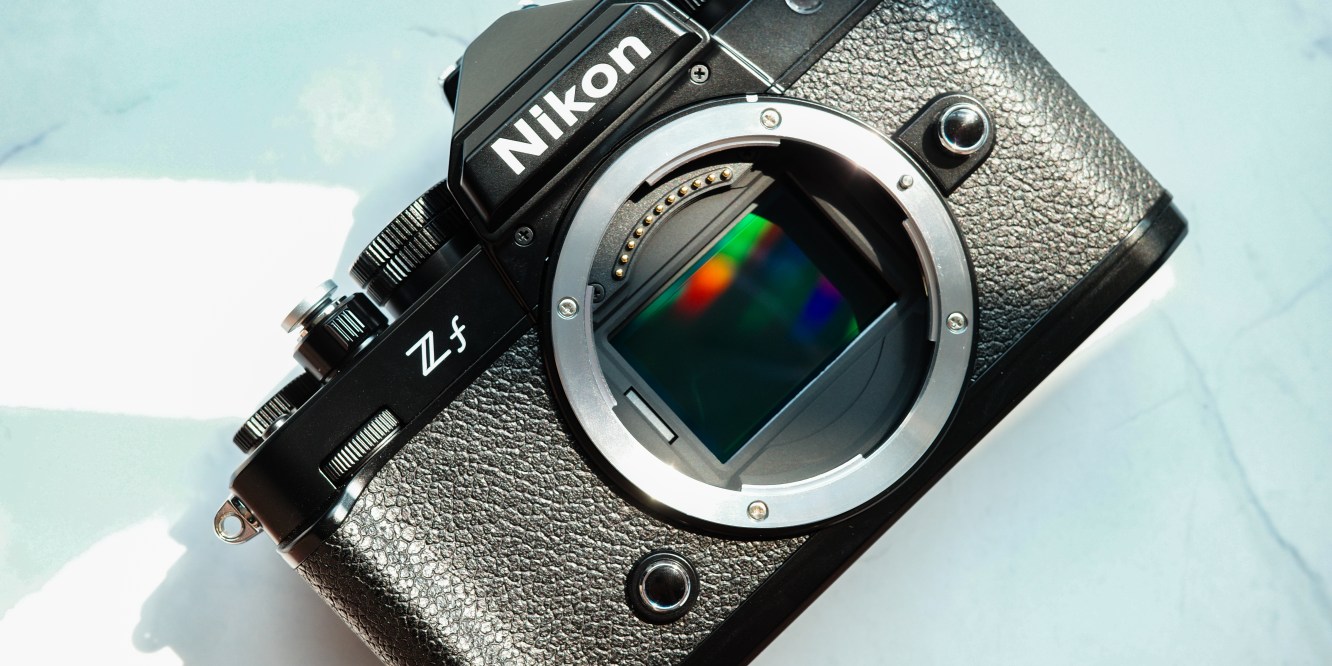
Introduction
It is not often that camera makers make good on customer requests, and a happy ending in the case of Nikon this round. Since 2021, many Nikon users have requested a full-frame equivalent of the APSC-sensor-sized Z fc (my review here). In a not-so-common scenario, Nikon granted this wish with the full-frame Nikon Zf released at the end of October 2023.
Let us take a closer look.

tl:dr
The Nikon Zf is a camera that excited many of my photography aficionados, even those who have not purchased a camera body in years. The Nikon Zf enters a crowded fray as a unique candidate with a gorgeous brass/magnesium alloy Nikon FM2-inspired body and the processing prowess of the higher-end Nikon Z8 and Z9 siblings.
Nikon has got a hit on their hands this round. In fact, it even got Canon excited enough to say that they are also considering a retro-inspired camera body (source here).

How my sharing will differ this time.
A visual sharing with my hands-on handling experience approach for this review.
I am primarily a user and see cameras and lenses as equipment and tools, and this round, instead of my usual hands-on manner review, I decided to simply pack the Nikon Zf and the two lenses, the Z 28mm ƒ2.8 and Z 40mm ƒ2 on a 5 days cycling trip across Taiwan.
The set-up was all packed into a Wotancraft Pilot 7L on a Brompton bicycle with one spare battery and an USB-C power bank for direct charging to work across the slopes, vibrations and weather elements.
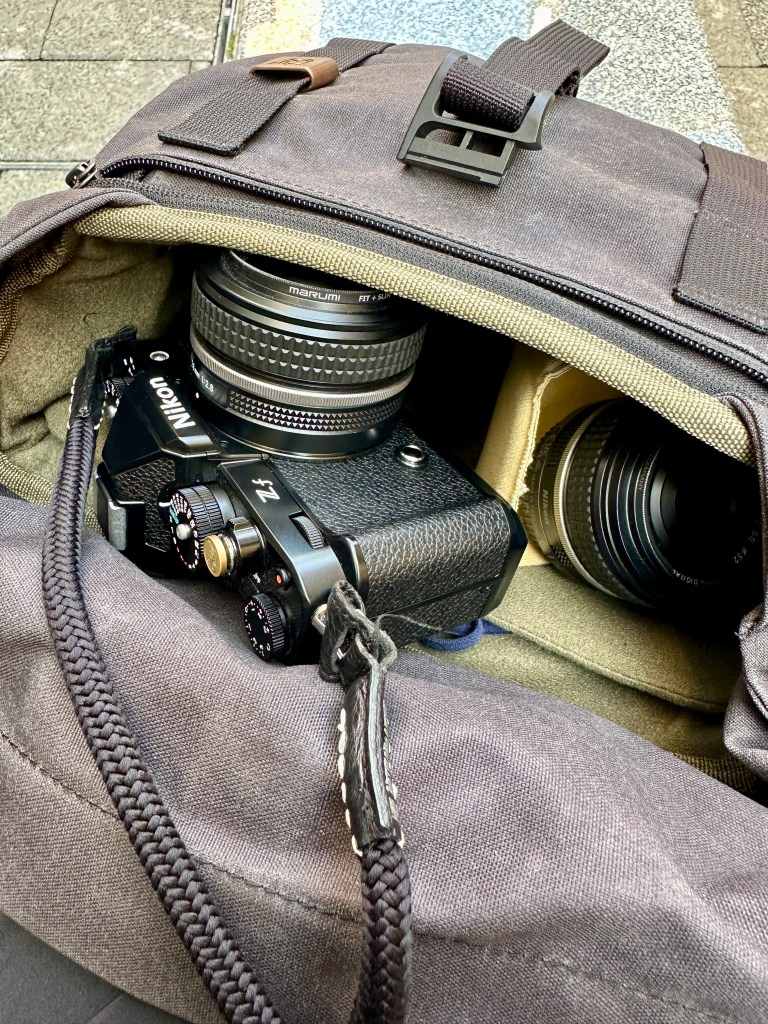
Instead of focusing on the specifications you can google anywhere, I will be doing more of a visual sharing of the images from the 24 megapixels Zf with two of Nikon Z’s system wallet-friendly lenses, the bundled Z 40mm ƒ2 and the 28mm ƒ2.8. And to note, the total cost of these two lenses is only around half of the Z 24-70mm ƒ4 S kit lens.
It still surprises me how the total cost of both the Z 28mm and 40mm lenses is around half of a Z 24-70mm F4 lens

The travel setup. This shot was taken at a rice field at Chi-Shang (池上)
And so, let us start the visual sharing


My primary concerns with the Zf and duo lenses kit were all dispelled on the first day of riding.
I was considering bringing a Z 24-120 S due to FOMO and thankfully I didn’t
Even though I have had positive experiences with Nikon’s equipment (the Z6 II and Z6), and while the Nikon Zf sports the same Expeed 7 imaging processor and auto-focusing algorithms as the Nikon Z8 and Nikon Z9, I guess some users were not the most excited about the inclusion of the 24 megapixels sensor from the Z6 II, but this concern was quickly dispelled when I started processing the shots.
If I was printing A0 size posters from a 16-megapixel sensor camera a few years ago, 24 megapixels would surely be enough unless the photographer is into some serious cropping.
Image quality from these two entry level lenses


To cut to the chase, both the Z lenses I had packed along performed way beyond my expectations, especially for the price point they are at in Nikon Z’s ecosystem. These two lenses will not win any awards for optical performance but make up for it with their compactness and auto-focusing performance.
If there was anything to pick at, there were certain times I wished for a faster lens for thinner depth-of-field, but at the end of the day, for travel shots where we do want the environment as part of the frame, both the Z 28mm ƒ2.8 and Z 40mm ƒ2 easily suffices.


And the scarier thing?
I have shot the S category lenses in Nikon Z mount, such as the Z 50mm ƒ1.2 S, Z 35mm Z ƒ1.8 S, and even the Z 70-200mm ƒ2.8 S (my reviews are linked on their names) and any of the S category lenses will provide even better image quality than the Z 28mm and Z40mm on this proven and reliable Z6 II era sensor.
Auto-focusing performance and reliability
With my last Nikon Z-camera being the Z6 II, I think it would be pretty fair to say that this was a concern I had, which was quickly cleared when I started testing it out in the field. Firstly, the subject detection system the Zf uses is the same as the one in the higher-end siblings, the Nikon Z8 and Z9, and it was as reliable as I needed it to be.
What I learnt testing another brand back then was, what is more important is the reliability and not the advertised speed of any autofocus system.
Nikon says that the improved face-detection algorithms now can detect faces as small as 3% of the frame. I am not that crazy enough to measure an exact 3% of a frame, but I can say that even for the shots below, the gentleman on his mountain bike had his face detected and tracked even while pretty distant from me.


Even when it was at night, with nightfall coming in around 17:30 hours in Taiwan during the November to December period, and I was a bit concerned about the reliability of the auto-focus system, the ZF’s auto-focus simply shrugged off my concerns, successfully and very reliably detecting various subjects in the frame, without the need to change settings.
The reliability of the auto-focus on the Zf impresses, in fact I could have simply shot the whole trip on AUTO subject detection mode, with the camera smartly detecting the subjects right and fast.


Additionally, face detection worked exceptionally well, detecting human faces well, making it convenient for portraits and filming subjects walking toward the camera from a distance, even in low-light situations down to -10 EV (what Nikon says).

Handling and that flip-out screen
Handling the Nikon Zf was a breeze; while I wish it came with a more substantial grip, it is good to know that SmallRig makes two excellent grips for those who need it. I will not likely be using any additional grips unless it is to handle a much larger lens.
Being very acquainted with physical dials from using Leica and Fujifilm cameras using the Nikon Zf was delightful. I especially liked the switch on the left side, which allows us to toggle between the PASM/Auto modes quickly.

I think the maximum size of native lenses I would work with the Nikon Zf would be the Z 35mm/50mm/85mm ƒ1.8 S lenses. I tried the Z 24-120mm ƒ4 S lens on it for another 2 hour shoot, and while the images delivered were outstanding, the set-up was indeed front heavy.

While some will prefer the more traditional tilt LCD design, the Nikon’s Zf design turned out pretty helpful for me for two reasons, one for wefies/selfies and the other allowing one to keep the LCD side tucked away safely while travelling.
Deep inside, I wished that the Fujifilm X-Pro3 had done this instead of a flawed, destined-to-fail design, as this would still have allowed the inclusion of the lovely mini LCD that gave the X-Pro3 its unique design which I really love.

Not as much shared by others, the Nikon Zf also comes equipped with a one-step switch to go directly into Monochrome mode. A lovely part is one can save more than one monochrome mode picture setting. As expected, if set to JPEG+RAW, images taken in this setting will be monochrome JPEGs and full color RAW files.

The shot below shows the output from a JPEG with one of the Nikon Zf’s monochrome modes.

Conclusions
For users of the Nikon Z ecosystem, the Zf is an appetizer of what the Z6 II and Z7 II successors can be and the sweet spot between the top-performing Z9 and the much costlier Z8.
For non-Nikon users, I see some long-time Leica users purchasing the Nikon Zf as a Leica SL equivalent, me inclusive. Some actually went for this camera simply because of its looks alone.

With the introduction of the Nikon Zf, it is quite obvious the Z6 III and Z7 III will follow next, completing the lineup with the 45.7 megapixels BSI CMOS sensor Z8 and 45.7 megapixels stacked sensor Z9.
The third generation Z6 and Z7 will easily fill the gap for those who doesn’t wish to pay for the Z8 and Z9 bodies and wish to use larger lenses while the Nikon Zf will be the option for those who will prefer a heritage-inspired design which is as much functional and powerful as its other Nikon siblings.

For me, the Nikon Zf satisfies my needs because it exceeds my expectations and fulfils my demands for what I want my camera to be. The biggest drawback of the Nikon Zf, which is that it gets unwieldy with larger lenses hardly affects me as I am clear that I will mostly be only using the compact Z 28mm ƒ2.8 and Z 40mm ƒ2 and adapting Leica M lenses to it.
Even as the Nikon Zf enters an already crowded fray of high-performing full-frame mirrorless cameras, it has already and will be a unique candidate that attracts its own following and use case.
Nikon has got it right this time around.
Thank you for reading.
Disclaimers.
- All product photos and samples here were photographed by me. I believe any reviewer with pride should produce their own product photos.
2. All images were shot with the Nikon Zf, the Z 28mm ƒ2.8, and Z 40mm ƒ2, all my personal copies.
3. This review is not sponsored. There is nothing to return this round as everything here is bought and paid for by me.
4. I do not do affiliate purchase links to keep myself neutral. I write as a passion and a hobby, and I appreciate that photography brands are kind enough to respect and work with me.
5. The best way to support me is to share the review, or you can always help support me by contributing to my fees to WordPress for the domain using the Paypal button at the bottom of the page.

 KeithWee | Photography
Thank you for this Keith. Awesome review.
LikeLiked by 1 person
Beautiful pictures of a beautiful country. Were there issues with the vibrations from the bicycle?
LikeLike
Hi, thank you. The vibrations from the bike frame was a worry hence why I used the Pilot 7L which is designed with the cushioning one finds in a camera bag while allowing one to fix it to the Brompton. So far thankfully it seems all is good.
LikeLike
Keith, this is such an interesting review, thank you. I’m one of those M-system photographers who’s been eyeing the Zf as an alternative to an SL2-S (or Q2). It seems like, if you’re aiming to build a handy autofocus system using those three options, you can do something like a Nikon Zf with 28mm and 40mm primes; an SL2-S with 24mm and 45mm primes (from Sigma); or a Q2 / Q3 with crop-to-zoom from 28mm (more like 26mm!) to 50mm and above. It’s a really tough choice between the three (and of course there are options from Fuji, etc.). The SL2-S seems like the best fit with M lenses, but it’s expensive. The Q2/3 is a nice self-contained system. The Zf is quite affordable and cool. As an M-shooter with a lot of M lenses, I’m torn! Are you settling on the Zf? What else did you consider? Many thanks for your excellent writing and photography.
LikeLiked by 1 person
Hi! Actually what your discussed is exactly what went through my mind, with the Zf as a very valid alternative to the SL series which is much bulkier and more costly.
Another big impt thing for M lenses on the Zf is the AF system auto detects eyes even if u are on manual focus and when u zoom in for focusing ; it directly zooms into the eyes instead of the ‘middle’, and with what Nikon Z lenses have been in quality , I really see the Zf as what replaces the SL fully and Yeap. I’ve fully settled on the Zf.
LikeLike
Fantastic review. I am a Leica M shooter that was going to buy the Q2 or Q3 but settled on the DF. I currently have the 28mm lens and my goal is to keep this kit simple and just shoot the 28 for a year or so. Although I have several Sony cameras, this is the first digital camera that I consider a friend. The design makes you want to pick it up and create magic.
LikeLiked by 1 person
Hi! Thank you for popping by and sharing too
LikeLike
Very nice thread. I like it very much. Nice bikes and nice girl, too. Greatings!
LikeLike
Thank you very much 🙏
LikeLike
Heya Keith. Thanks for the very real world review. I wanted to ask about color. In your Leica reviews I love the color rendering, and it reminds me of Leica color in my own photos. The color here feels very intense and saturated- blue is BLUE, green is GREEN ha. Is that how the default color science handles shots from this body?
LikeLike
Hi thank you for popping by.
For the photos shared here in the Zf review, color wise I’ll say that for some of the shots ; say those with landscape I have edited it to be BLUE from blue etc, and overall if we use sooc from the Zf it is generally slightly not as saturated as you will see here. Different Z lenses do also render differently, for example output from the Z35/1.8S is more saturated and contrasty than the Z35/1.4.
It gets even more fun when you try mounting Leica M lenses on the Zf 🙂
LikeLike
I have a z6II and trying to find something smaller for a Europe trip to carry around next summer, is this that smaller but still full image option or is it just as heavy to carry around as the z6II? Is it too much to spend if I already have the z6II?
LikeLike
Hi Melody, thank you for popping by. The Zf is slightly smaller than the Z6 II mostly because rig its grip design differences.
To me the bigger factor is probably the lens one uses, in my case the Z28/2.8 and Z40/2 aided more to a more compact kit versus the body size and weight differences.
For example Zf with a Z35/1:8 is still hardly small and using a Z6 II or Zf won’t matter much here due to the length of the lens.
Hope this helps.
LikeLiked by 1 person
Thanks! Yea I might have to try it out with the smaller lenses.
LikeLiked by 1 person