Introduction
There are film cameras that exist to be efficient, and there are film cameras that exist to be felt.
The 2025 Lomography Lomo MC-A is, unapologetically, designed for the second camp, but with a twist: it is not a toy like the Kodak Charmera (my review linked), and it’s not a nostalgic remake either and instead, a brand new modern camera designed from the ground up.
The Lomo MC-A is the answer to the enduring question of: “what if someone built a brand-new 35mm compact with modern conveniences, and still gave photographers real control?“

That premise matters because the MC-A isn’t trying to compete with yesterday’s cult compacts like the Contax T3 or Nikon 35Ti on scarcity or myth. Instead, Lomography is positioning it as a fresh-built, metal-bodied, autofocus point-and-shoot that includes a full suite of modes with Program Auto, Aperture Priority, and Full Manual exposure, plus zone focusing capabilities with a built-in flash.
Let’s take a deeper look.

The samples shared in this review were developed and scanned at a local photo shop, K100 Colour Photo Service Centre and shot with Kodak Portra 400.
tl:dr
The Lomo MC-A is a new-production, metal-bodied 35mm compact built around a 32mm ƒ2.8 multi-coated glass lens, with autofocus plus zone focusing. Unlike most cameras in this category, it also brings not-common complete manual controls to the user.
What makes it compelling is the “serious camera” features set in a modern compact: manual shutter speeds, PC sync, multiple exposure, bulb mode, and a manual ISO override: options you rarely see offered together in a film camera you can buy new with a two year warranty.

There are some trade-offs, after all no camera is perfect. The manual film advance has a relatively long throw, and you can miss shots if you don’t complete the ‘wind’ with the manual highlighting this and the viewfinder could be bigger.
Overall, it is aimed squarely at anyone who wants a reliable, brand new film compact that can be shot casually or deliberately, without paying collector prices for a 1980s to 1990s camera.

For further reading, my favorite film cameras are the Leica MP, the Nikon 35Ti, and kudos to Pentax for releasing the Pentax 17, a legitimate new camera also built from scratch.
Technicalities
- Film format: 35mm (full frame)
- Lens: 32mm ƒ2.8, multi-coated glass, 5 elements in 5 groups with a 30.5mm filter thread
- Aperture setting options at: ƒ2.8, ƒ4, ƒ5.6, ƒ8, ƒ11, ƒ16

Exposure & modes
- Modes: Program Auto (“P”), Aperture Priority, Full Manual
- Shutter: Auto 1/500–20s; Manual 1/500–1s + Bulb
- ISO: DX reading + manual override, ISO 12–ISO 3200
- Exposure compensation: -2 to +2 EV
Focus
- LiDAR-based autofocus close focus: 0.4m
- Zone focus distances: 0.4 / 0.8 / 1.5 / 3m / ∞

Flash & connectivity
- Built-in flash + PC sync
- Flash guide number: GN 9 (approx. 3.2m at ISO100 ƒ2.8)
- Works with Lomography’s color gels (included as part of “creative” accessories in box)

- Battery: CR2 (3V) or rechargeable CR2 (3.7V) Lomography provides a USB-C rechargeable battery

- Dimensions: 125.8 × 69.5 × 42mm
- Weight: around 332g without battery
Key points regarding Handling
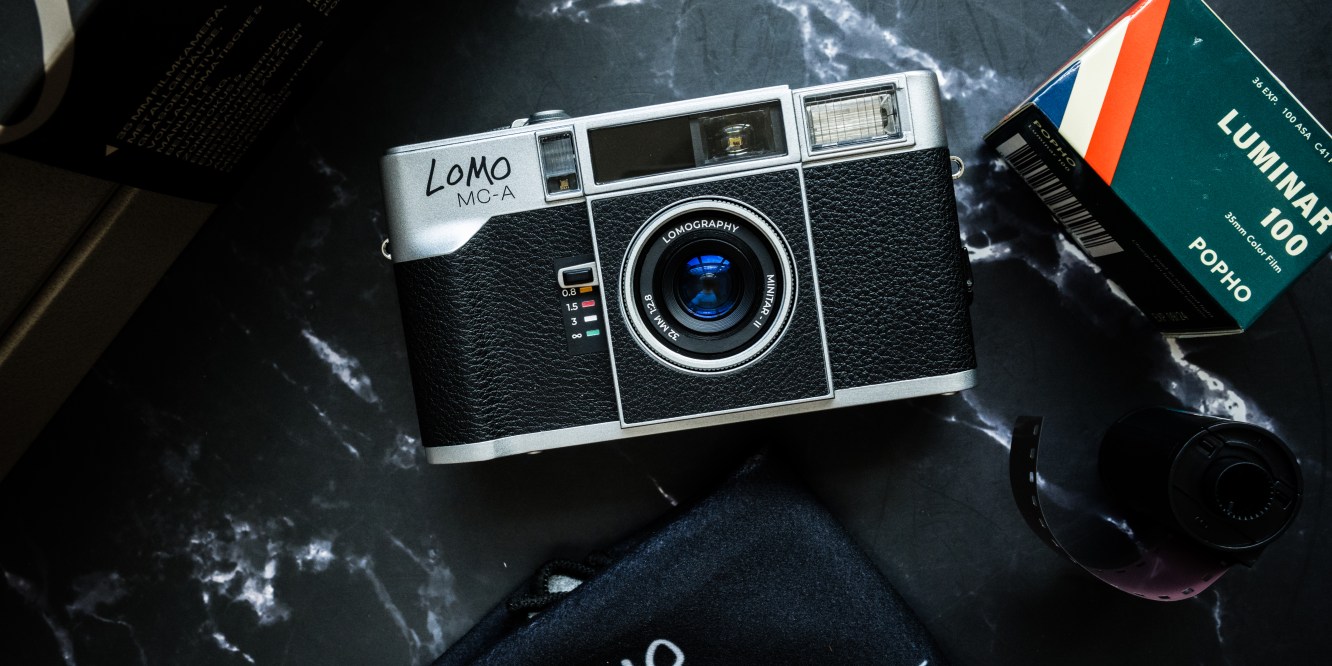
If you are familiar with Lomography’s offerings, the ergonomics of the Lomo MC-A are a departure from the “toyish-plastic dominant’ feel of the usual Lomo offerings. The metal chassis gives it a more premium heft that reminds me of the Ricoh GR series. (in fact the MC-A weighs more than the GR IV)

the MC-A’s tagline “Everybody is equal before the lens and behind it” is emblazoned clearly across the top plate.
Operating the camera is a tactile delight. The aperture is adjusted via a ring around the lens which protudes slightly when the camera is switched on while the top plate houses dedicated dials for shutter speed and exposure compensation (+/- 2 EV).
The small LCD on the top left is a modern touch, clearly displaying your frame count, battery life, and flash settings.

One quirk that takes some getting used to is the manual film advance despite all the other modern conveniences in the Lomo MC-A. It’s a very long throw, and you need to ensure you pull it all the way to avoid the shutter locking. (which you need to undergo a series of steps to unlock)
The shutter button itself has a distinct two-stage feel: half-press to lock focus (confirmed on the LCD) and a full press to fire. There’s a soft shutter sound and in fact the lens makes a soft ‘whirl’ sound when switched on but generally its hardly what you will consider loud.


Autofocus was generally reliable, but one does need to take note of the minimum focusing distance of 40 cm. Out of a roll of 36 exposures, I had around 2 shots out of focus, one was done too close and one was shot in dim light which to be fair, can be attributed more to user error.


Personally I quite like the on/off switch design which doubles as a AF/zone focus selector, which is actually a practical design choice: less accidental activation in a bag, less mystery battery drain, fewer “why is my lens extended?” moments.
“P” mode exists, and it is never a shame to use it.
Two to three weeks into using the Lomo MC-A, I have grown to appreciate the Program Auto or “P” mode denoted by a “P” marking near the ƒ2.8 position on the aperture ring that is easy to overlook, and selecting it enables a mode where the camera decides on the optimum aperture and shutter speed while you focus on framing the image. A tiny detail, but it can be the difference between “this feels like a lot to fiddle with” and “this is my everyday carry film compact.”

There were a few moments where I wished the viewfinder could have been larger, especially to accomodate glass-wearers but in all, the size still suffices for framing the shot.

Similar to the manual film advancement design, rewinding is also fully manual. Activate it by depressing the button on the base, detach the rewind lever and start turning until you feel no more resistance. I was quite surprised at the number of rounds needed for the usual roll of 36 exposures but then, hardly an issue and I guess an activity some might actually enjoy.


The 32mm ƒ2.8 lens is a sweet focal length for real life, close to the most widely used focal length of 28mm: wide enough to breathe, but not so wide that people become background accessories. While it will not be the sharpest or best quality piece of optics available in the market, it is good enough for the moments one wishes to capture on the Lomo MC-A.

The Lomography DNA is strong that one does get lots of flare etc when shooting directly into sunlight etc, adding to the element of ‘expecting the unexpected’ that some of us have gotten acquainted with using Lomography’s cameras.
Conclusions
The Lomo MC-A represents a significant pivot for Lomography. Moving away from the “plastic is fantastic” era, the MC-A is a robust, metal-bodied compact designed to compete in a resurging market for premium film point-and-shoots.

The Lomography Lomo MC-A is compelling because it feels like a camera that finally acknowledges what many film shooters actually want and actually get in 2025: the convenience of a modern compact, paired with the option to be deliberate when the moment deserves it, and all in a price that steps clearly away from trying to being ‘unaffordable’ for the everyday film photographer.

At US$549, it sits in a space where it has to justify itself not merely as a fun novelty, but as a dependable, frequently used companion. Honestly, given how inflated prices have become, I would have expected Lomography to charge more for a brand-new, feature-rich, well-built film camera; one that also frees me from the usual anxieties of buying a decades-old film body.
Also, credit where it is due, the Lomo MC-A is delivered in a packaging quality that gives you the vibes that the Lomography team is proud of this release.

Unlike some other releases, you do get the full set of accessories, down to a camera wrap, UV filter and a photo book showing creative samples seeking to aspire.

*note: for Singaporean readers, this translates to around SGD699, with further goverment taxes of around SGD85 (including Fedex’s infamous additional processing fees of SGD20)
Thank you for reading.
Disclaimers:
- All product photos and samples here were photographed by me. I believe any reviewer with pride should produce their own product photos.
2. All images were shot with my personal set of the Lomo MC-A .
3. This review is not sponsored. I paid for the Lomo MC-A, the film, and development costs.
4. I write as a passion and a hobby, and I appreciate that photography brands are kind enough to respect and work with me.
5. The best way to support me is to share the review, or you can always help support me by contributing to my fees to WordPress for the domain using the Paypal button at the bottom of the page.

 KeithWee | Photography
Thank you for a great review Keith, I noticed that you also have the Nikon 35 Ti and may I know which of this do you prefer?
LikeLike
Hi, thank you for popping by. The 35Ti is still better built (you know, from the era where things were made to last) and comes fully automatic including rewinding with a very sexy top panel and a very good quality set of optics – so yes, I do prefer that.
However, caveat is that the 35Ti prob easily costs 40% more than a brand new MC-A and if it breaks, there is no guarantee it is fixable.
LikeLike
Keith, great review. I have an MC-A and am working on a review for it and am coming to some of the same conclusions as you.
I wanted to ask if you would give me your permission to use one of the images of your camera in my review. I have the black one and am looking for a head on shot of the silver one. I was hoping to use the one right after your Introduction. I will give you image credit and link back to this review. Thanks! 🙂
LikeLike
Hi Mike, thanks for dropping by and checking in. No problem with the use of the image you mentioned and I’m looking forward to your review.
Also, if you prefer I can also email you a higher res version of the image. just drop me an email at moostar@gmail.com
Cheers
LikeLike
Thank you! I will send you a link once I have the article live. Thanks for the offer to send me the image, but I was able to download a hi resolution version from your Flickr page! 🙂
LikeLike
Oki, all good 🙂
LikeLike
Hello Keith,
First time visitor to your blog, found when I did a search for “Lomography Lomo MC-A Review”. Well presented information and I enjoyed your writing style. I am a dedicated BNW Film Photographer who owns two Canon EOS-1N bodies along with Canon EF 35mm, 85mm, 135mm Soft Focus and 100mm Macro lenses for my “serious” BNW Photography…all of which I love for ergonomics and build quality.
I’ve been hunting for a film EDC which is new construction and that can fit in my shoulder bag and checked out both the ROLLEI 35AF (way too expensive for what you get) and the LOMO MC-A. Since this is an unsponsored purchase review…is there anything you found to be a serious negative for your LOMO MC-A? So you can see what I shoot, here’s a link to my Linktr.ee account https://linktr.ee/dave.bnwbistro … is the LOMO MC-A a viable EDC ?
LikeLike
Hi,
Thank you for dropping by 🙂
With the equipment you are using plus what you shared about you enjoyed the ergonomics and build quality of the Canon setup, my take might be quite different as the glass will matter quite a lot to you beyond the build.
I have 1 issue with the LOMO MC-A which is build, especially the ‘cocking’ which can feel very ‘draggy’ at times , till the point where I worry something might snap if I push the lever to the end.
I have not used the Rollei 35AF and in this sense not fair for me to comment but it seems to have a fair share of build issues, in fact more than the Lomo MC-A
In the end out of the modern ones I have tried the Pentax 17 seems to be the most well built and with decently sharp glass (but it does not have AF and uses zone focusing) – and for a forever EDC that I have zero complaints about it will probably be the Nikon 35Ti (yes , old but it soundly beats the options here)
If you prefer a new camera I will say do give the Lomo a try but before so , read up online about the potential issues it may have , their customer service responds fast and that is a huge advantage.
LikeLike