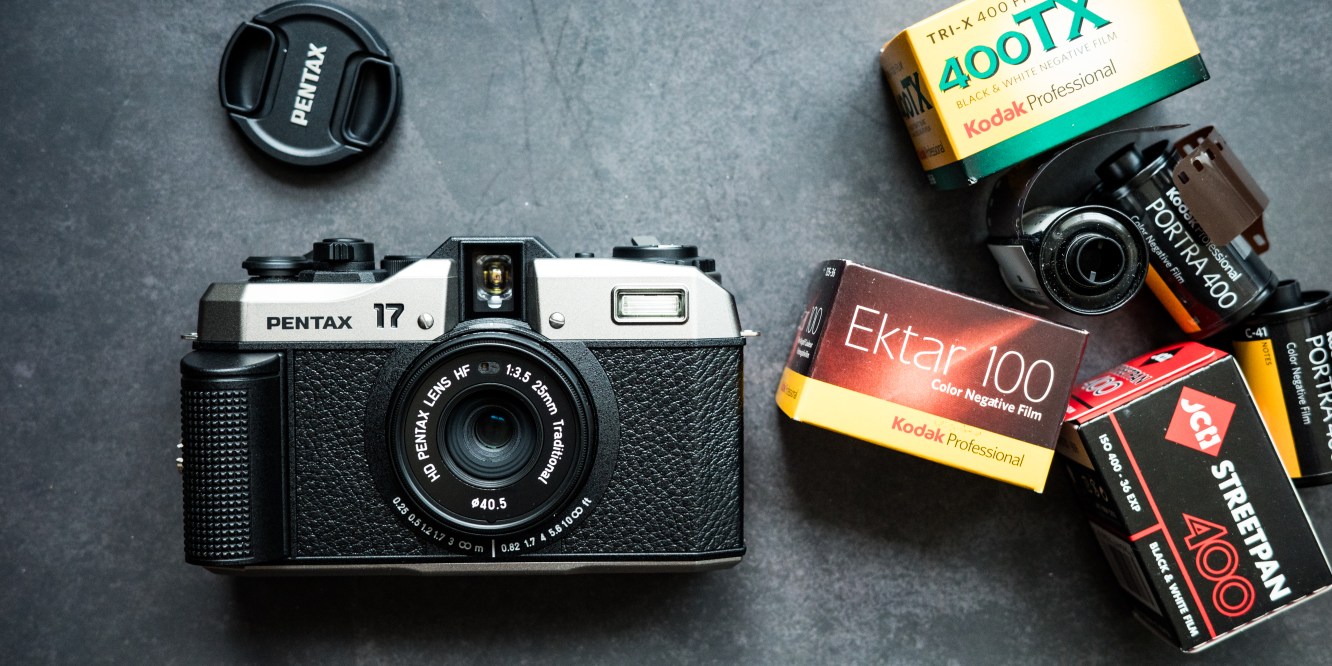
When Ricoh Imaging announced on 1st March 2024 their progress to the next stage of development in the December 2022 PENTAX Film Camera Project, it was undoubtedly an exciting moment for many analog enthusiasts. July 2024 soon arrived, and the Pentax 17 units started to ship.

While the local distributor for the Pentax 17 was unfortunately not helpful in the review, I appreciate the assistance of Mr. Yun of BIC Camera and a dear friend, Mr. Victor, in helping me secure a copy for this review.
A key point here was Pentax’s commitment to the development and realisation of a brand new film camera in modern times, and not indulge in another lame rebrand or a rehash.

tl:dr
I have to give Ricoh Pentax credit for the courage to design and produce a new film camera in a world where some brands sell incremental updates as the next big thing. I love how Ricoh Pentax has looked back at its key models across its history and incorporated design elements in the Pentax 17 in a proud nod to Pentax’s heritage.

While there are areas for improvement, as elaborated below, there is no doubt the Pentax 17 is a true ‘new’ camera and has the potential to create excellent images with its accurate exposure metering and decently well-designed optics while at the same time being fun and easy to operate for the beginner.
Throughout the camera, it is clear that the designers had taken a lot of care with even the minute details, for example, in incorporating certain elements such as a manual film advance lever and rewind feature, which will allow (especially new to film) users the appreciation of the fun and techniques of analog and even darkroom photography.


Disclaimers:
- Reviews are aplenty, obviously; hence, instead of just another technical-based review regurgitating specifications, I will elaborate on the 5 key areas anyone considering this camera should note.
2. I am hardly a competent film photographer, and I am sure many others with better scanners and skills can produce better samples than the ones I share here.
Technicalities
- Half-frame film format using 35mm film
- 25mm ƒ3.5 lens (equivalent to 37mm) with 9 aperture blades and 3 elements in 3 groups.
- Manual focus with 6 zones, with a 25cm to infinity focal range.
- Shutter speed from 1/350s to 4 seconds and bulb mode.
- ASA film speed options from ISO50 to ISO3200
- Built-in flash at GN 6m at ISO 100 with approx 9 seconds recycle time
- at 127 x 78 x 52 mm and 290 grams (without film and CR2 battery)
Why 17?
Because it is a Prime number (no, I am just joking here)
I was asked by a few users why ’17’ was used in the name of Pentax’s new film camera, and the answer is in Pentax’s tradition of using the format for naming purposes. The ’17’ is a nod to the half-frame size.

No one is sure what the next iteration will be named, but one thing for sure is that the Pentax 17 is here to stay for a while.


5 key points to note about the Pentax 17
One – The Pentax 17 is a half-frame camera.
While the most popular film format is the 35mm (36mm x 24mm frame size), the Pentax 17 is a half-frame camera where two pictures (17mm x 24mm) are captured in a single 35mm-format frame, which means one can double the number of pictures that can be captured on a single roll of film — 72 pictures on a roll of 36-exposure film.

In fact, one can observe that the guiding boxes for framing are vertical in the optical viewfinder for the Pentax 17. This allows the user to hold the camera horizontally, with the viewfinder already accounting for the half-frame format. One simply turns the camera 90 degrees to hold the camera vertically to capture an image in landscape orientation.

The OVF framelines are such that holding the camera vertical gives you a landscape orientated shot while holding it horizontally as usual gives us a standard orientated shot.
While I am primarily a full-frame user (with my Leica MP and Nikon 35Ti), I do realize there are advantages of a half-frame camera, which is, of course, that the user gets double the number of exposures. Still, of course, this comes with trade-offs.

With half-frame, costs are literally halved but with the trade-offs of a smaller image area which records less fine detail.
For those who struggle to finish a standard roll of 36 exposures, you might of course (haha) find now that 72 frames may not be easy to finish.

Two – There is no PASM modes but you do get 7 exposure programme modes
To ease the user into operating the camera, the Pentax 7 comes with 7 shooting modes. The camera has seven exposure program modes on a dial by the shutter button, including a straightforward Full Auto (fixed-focus, regardless of where the focus scale is set, P (standard mode) for general daylight photography, Slow Speed mode for dim conditions, P-Flash (daylight sync mode), Bulb shutter mode, a Slow-synch flash mode, and a ‘Bokeh‘ mode which is aperture-priority at maximum aperture.

Each of these modes serves a logical, specific purpose. Still, I reckon most users will simply go with P (standard) mode when photographing outdoors while only defaulting to AUTO and BOKEH when needed.


One thing to note for portrait photographers is that the Pentax 17 will automatically try to shoot with a wide-open aperture in bokeh mode. At ƒ3.5 and for single-person portraits (using the correct zone focusing mode), it is possible to get a shallow depth of field. Otherwise, in Auto mode, one simply gets everything in focus across the frame (assuming you have set the focus distance right)
Three – So, What is great about the Pentax 17?
A fixed lens camera is only as great as its optics, and the Pentax 17 uses a pretty well-designed fixed 25mm ƒ3.5 lens (equivalent to 37mm on a 35mm / full-frame camera) with a nine-bladed aperture and a very useful range of 0.25 meters to infinity.
The lens has no autofocus, but it isn’t fully manual focusing — you use zone focusing by picking from one of six set distances ranging from as close as 0.25 meters in macro mode to infinity, making the Pentax 17 (in my opinion) more of a snapshot camera.

The engineers have also cleverly built in modern conveniences into the camera, for example warning lights near the OVF blink should you forget to remove the lens cap or advance the film for the next shot.
Another point note is that the Pentax 17’s lens is pretty sharp, with its design combining elements of the lenses used in the Ricoh Auto Half and the Pentax Espio Mini, and results in a 25mm ƒ3.5 optic that’s effectively a 37mm lens in the half-frame format.


The Pentax 17 has an accurate built-in meter on the lens, which will set the shutter speed based on the shooting mode and ISO film selection. This is pretty smart, allowing the Pentax 17 to detect if the lens cap is left on, and it will not take a photo until you remove the cap; this should also mean that the meter will automatically adjust the exposure when you attach a filter to the lens.
Ricoh Pentax could have made a fully automatic camera, but instead decided to include elements such as a manual film advance lever and rewind to remind us of the ‘fun’ which, in my personal experience, isn’t too bad and something I enjoy.

Four – Things I wish the Pentax 17 could have been:
I wish the Pentax 17 could have been an auto-focus camera instead of the zone-focus camera it is. That said, it is still extremely easy to find approximate focus with the Pentax 17 using the series of 6 distance-based symbols one can find on the top of the lens barrel.

While every reviewer will tell you that the focus is controlled by a series of 6 distance-symbol markings on the top part of the lens element, what is often missed is that below the barrel, one can find a series of helpful focus scales in meters and feet.
Personally I prefer using the distance scale at the bottom of the barrel instead.

When using the camera, one simply sets to one of six fixed distances on the scale, the shortest being 0.25m. Although the scale setting is manual, the lens itself is electrically moved to the set position when the shutter button is pressed, making me ponder whether Pentax will release one with auto-focus next?

The Pentax 17 does not come with a full manual mode; one cannot set shutter speeds or aperture size separately and you can only set Exposure compensation. This might not be the most welcome to experienced users who prefer more control. There were times when I had wished for at least an Aperture or Shutter Speed mode.


Five – Then, who is this camera designed for?

According to Pentax’s sharing, well, the Y and Z generations, but to me, the camera was designed for anyone keen to step into a more serious film camera from disposables and, in my opinion, someone who is also comfortable with a snap-and-go type of camera due to the lack of Aperture-Shutter Speed-Manual modes on the Pentax 17.
There are obviously film camera alternatives with more functions available in the market. Still, these options, such as the Leica M film series, Nikon 28/35Ti, GR 1 series, Contax series cameras, and on, though most of them are much more costly and generally difficult to service due to their age.
Fact is that only two (and one more) brands are making film cameras now, Pentax, Leica and also Rollei (which is technically MiNT cameras) and the Pentax is the most accessible cost wise.

Conclusions
When the Pentax 17’s specifications were announced, there was quite a bit of noise about it being a half-frame camera, with some users swearing off it. Still, in my opinion, this was an appropriate decision following the design intent of the Pentax 17.

The Pentax 17, while the accumulation of Pentax’s efforts over a good 3 to 4 years, is not a camera to be taken too seriously and not likely to be the camera of choice for experienced film photographers who are particular about control and squeezing out every little bit of image quality.
In fact, Pentax themselves were pretty truthful that the Pentax 17 was designed to bring more users into the fold of film photography, users who are novices, those upgrading from disposable cameras and (oh well) those who use ‘fake’ film apps on their mobile phones and in this sense, I firmly believe that Pentax has achieved what they set out to do with the Pentax 17.

Thank you for reading.
Disclaimers:
- I photographed all product photos and samples here. I believe any reviewer with pride should produce their own product photos.
2. All images were shot with the Pentax 17 and Kodak Portra 400, developed and scanned at the neighborhood film shop. The Pentax 17 is my personal set and running the most current firmware version. 😬.
3. This review is not sponsored; I write as a passion and hobby, and I appreciate that photography brands are kind enough to respect and work with me.
4. The best way to support me is to share the review, or you can always help support the site by contributing to my fees to WordPress using the PayPal button at the bottom of the page.

 KeithWee | Photography
Well written piece of work Keith. I am glad that you decided to review the 17.
LikeLike
Hi there, thank you for the kind words 🙏
LikeLike
hi Keith, out of curiosity, is there any extra steps needed in the process of scanning half frame shots?
LikeLike
Hi! To make it as fair as possible I didn’t use any personal scanning equipment and did the developing (C41 is easy) and scanning at a shop. All I did was to remind them that this roll was from a half frame camera and they will know how to follow up.
LikeLike
Bravo! Lovely informative review you have here.
I am awaiting the Rollei 35AF to be available and then making a choice between the two.
LikeLike
Hi there, thank you. Similar to you I’m also looking forward to testing the Rollei 35AF when it’s available, with the expectation that both the Pentax 17 and Rollei 35AF are two quite different cameras
LikeLike
Besides half frame vs full frame film, these new cameras might be for different types of people.
Pentax 17: auto exposure, manual focus
Rollei 35Af: manual exposure, auto focus
LikeLike
Good points, the Rollei 35AF seems to shape up to be the more versatile camera imo , but of course is much more costly.
LikeLike
thanks for your brilliant review. I’ve just picked one up to shoot some snaps at a wedding this weekend with some porta 400. Did you set the camera to 400 speed for the porta 400 film? I’ve read a few saying that it’s better to have it set at 200 but your pictures look great in the bright conditions. Thanks, Josh
LikeLike
Hi Josh , thank you for popping by 🙂 personally I do feel the scans by the shop could have been done better haha.
I do generally set the ISO accordingly for fresh film and only play around with ISO only for expired film. But that’s an interesting idea you shared and let me get to try the ISO200 for Portra 400. and see how it works out.
LikeLike