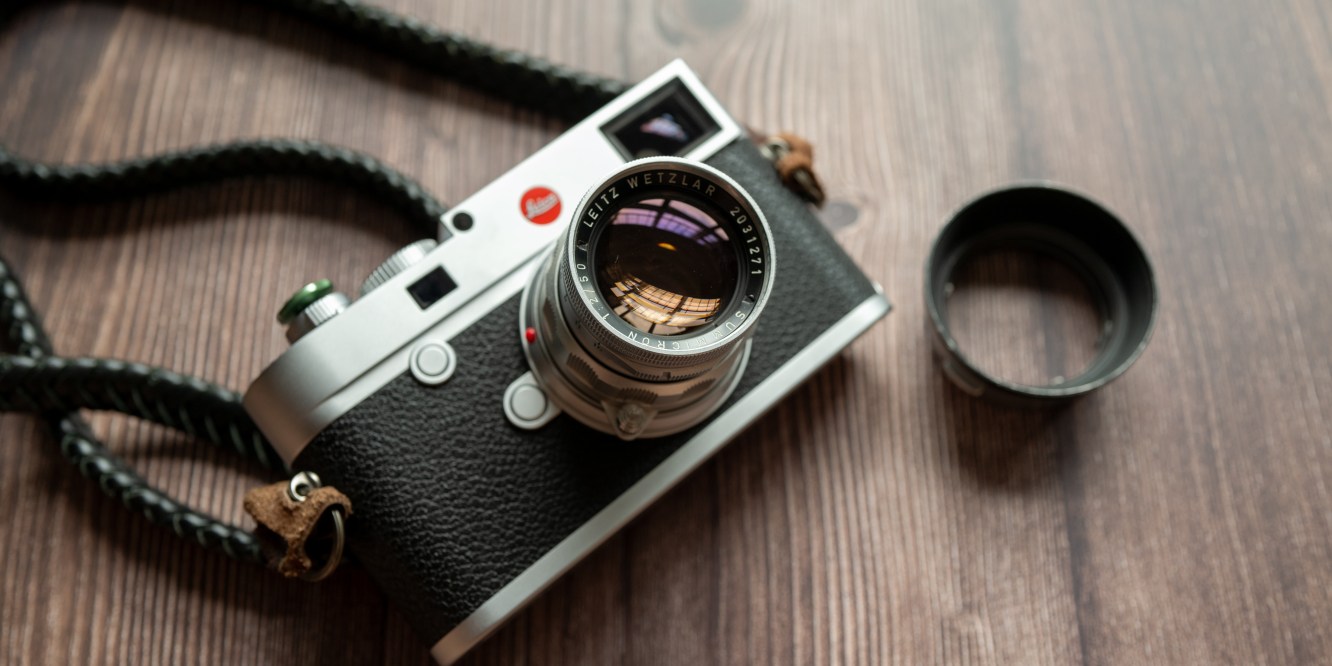
Introduction
*This is part 1 of 2 of the Leica Summicron 50mm F2 Rigid review. Part 2 (Street photography themed) is TBC.
I am hardly a 50mm focal length person, preferring to stick to my Leica 35mm Summilux FLE or my Leica 35mm Summicron v4 K.O.B for my daily moments, but when the need arises for portraits, I turn to 50mm lenses, and the Leica 50mm Summicron Rigid is one of the 50mm M-mount lenses I will always consider.

Let us look closer at this piece of Leica optics that is over half a century old, and what some say, Leica’s serious response to Canon and Nikon back then when it realised the Collapsible wasn’t going head to head with the competitor’s offerings.
For the sake of brevity, I will not type ƒ2 when mentioning the lens here, as the name Summicron suffices.
I have a self imposed limit of two 35mm and two 50mm Leica M-mount lenses at any time and the 50mm Summicron Rigid holds a spot.
Well, to be honest I can’t afford to amass a collection, and the other 50mm is the Summilux 50mm APSH (ver 1)
tl:dr
I am sure we all know how the marketing department would love to entice you to buy into the newest lens release that comes with aspherical elements, close focusing capabilities, or even the apochromatic version, and well, the Leica 50mm Summicron Rigid has none of these.
I have tested the 50mm F1 Noctilux Version 1, 50mm Noctilux F0.95 and on, these are great legendary lenses but the Rigid, even at a much slower maximum F2 is still special.

However, this is hardly to say the Leica 50mm Summicron Rigid is a lesser lens as instead of these, it presents its own unique rendering one can’t find in modern lenses, bettered by how beautiful this more than half-century old lens is designed versus modern run-of-the-mill designs.
In fact, the prices for the 50mm Summicron Rigid has rose significantly in recent years due to that a good condition copy is increasingly tough to find.
Around USD2500 now for a decent copy from below USD1000 just a few years ago.
Rigid, what?
The first 50mm lenses released in 1953 from Leica featured collapsible designs, and the nickname ‘Rigid’ stuck because this was the first 50mm Summicron with a fixed barrel design.
It is important to note there are two versions of the 50mm Summicron Rigid, with the first version spotting a distance scale only in feet while the second version has the distance scale markings in both feet and meters. I believe both versions sport the same optical design with only differences in the coating, and version 1 is more susceptible to glow/flaring.

Technicalities
The lens being discussed today is the Leica Summicron 50mm ƒ2 Rigid version 2, which I will refer to as the Leica Summicron 50mm Rigid for short.
Production was between 1956 and 1968, and the Rigid was produced in the (then) new Leica M mount and the Leica M39 screw mount, ironically the rarer version. Not often mentioned is that the Leica 50mm Summicron Rigid also comes equipped with an infinity lock on its focusing ring.

The Leica Summicron 50mm Rigid has a ten-aperture blade design with full stop clicks from ƒ2 to ƒ16 and seven elements in six groups. The lens was commonly seen with the Leica M3, and it has a minimum focus distance of 1 meter. In fact, the 50mm Summicron series was only updated to the standard 0.7 meter mimimum focusing distance in 1969 with the introduction of the Leica 50mm Summicron Version 3.
The 50mm Summicron Rigid has a maximum aperture of ƒ2; hence if you only allow yourself to photograph with only a Summilux or Noctilux, this lens is probably not for you.
Handling and performance
The 50mm Summicron Rigid is a beautiful lens and excellent in its rendering, in terms of transition and tonality, with just a perfect amount of sharpness and contrast.

At only 251 grams, the 50mm Summicron Rigid is compact portable and true to the M rangefinder’s design DNA and will hardly register in anyone’s eyes while on the streets.
One of the most attractive characteristics of this lens is that it is sharp enough without being too sharp, making it an attractive option for portraits.
Add in its own characteristic bokeh with a slight painterly swirl, the smooth transition and the slightly muted colours it renders, one has the sum of parts that make the 50mm Summicron Rigid an attractive choice.

A lot of modern lenses are simply well, too sharp and while they may rank high in the MTF charts, can be too clinical at times .
The Leica 50mm Summicron Rigid handles like most Leica lenses, with a good heft of quality and a focus ring that is smoothly damped and well balanced on any M-body. The only complaint I guess anyone can have is probably with the infinity lock, as this is one function that might need a bit getting used to.


The characteristic Leica micro-contrast is present even if this is a vintage piece of lens, and even at wide open, there is little loss of contrast, and the Leica 50 Summicron Rigid is sharp across the frame going to ƒ4 and smaller.


The Leica 50mm Summicron also performs well for black and white photographs, providing a good amount of contrast balanced with a touch of softness to the image.

I have read how some users love the Leica 50mm Summicron Rigid for how it outputs black-and-white images, and I hope to use this lens on pure black-and-white film soon to see the results.

Nothing is perfect, and the reasons behind the rise in prices.
I can share three key reasons for the rising value of the Leica 50mm Summicron Rigid, and the first is that the optics in the lens is relatively prone to haze. This is compounded by how soft the original lens coating is, making it almost impossible to clean off haze (or fungus) without leaving cleaning marks. In fact, most copies I have come across have some form of cleaning marks.

Thirdly, separation is also common in the Summicron Rigid and Dual range, but I believe this is not 100% verified. Some users have blamed this on poor storage conditions (such as high heat), and some on the material used to glue the elements together, which simply couldn’t stand the test of time (remember, even the youngest 50mm Summicron Rigid is 55 years old)
Therefore, if you come across a copy in excellent condition, keep it!
Given that haze, separation, and cleaning marks have a direct negative impact on the lens’ optical performance, copies in excellent condition have only got rare as time passed for an easily 60 years old lens, and the Summicron 50mm Rigid has only risen in value.

Not commonly shared, the 50mm Summicron Rigid can also be unscrewed apart, with matching serial numbers on the bottom barrel and top part holding the glass elements. I have heard of unscrupulous resellers mixing-and-matching top and bottom parts from different sets to seek a higher asking price.
Taught to me by the boss of Drew and Barry
Conclusions
Of course at the end of the day, I do understand that the preference for lenses is subjective, with some photographers having their knees go weak over the modern clinical sharpness and the almost perfect chromatic aberration control which the modern Leica APO series presents while some have the ultimate fondness for the rendering of lenses from decades ago, where the deficiencies of the lenses ended up as ‘character’ to these lenses.

As a reviewer, it is not my place to decide which is better or more suitable for you but to only present the options fairly, but for what I photograph and have a soft spot for, the Leica 50mm Summicron Rigid ticks all the boxes.
Thank you for reading.
Disclaimers:
- All product photos and samples here were photographed by me. I believe any reviewer with pride should produce their own product photos.
2. All images were shot with my personal set of the Leica M10-R and Leica 50mm Summicron Rigid, and all files were edited in LR CC Classic to my preferences.
3. This review is not sponsored.
4. I do not do affiliate purchase links to keep myself neutral. I write as a passion and a hobby, and I appreciate that photography brands are kind enough to respect and work with me.
5. The best way to support me is to share the review, or you can always help support me by contributing to my fees to WordPress for the domain using the Paypal button at the bottom of the page.

 KeithWee | Photography
Beautiful writeup you did Keith. But now the lens is going to be even more expensive.
LikeLike
Haha, hi, thank you for the kind words too.
LikeLike
Thank you for this review Keith. I find it fascinating how these old lenses are still so relevant today.
LikeLike
Thank you Kin. The scary part I realize is in the M
Universe of lenses, it is indeed a never ending slippery slope haha
LikeLike
Love your stories Keith – they inspire me to go out and shoot more!
Just a thought : Looking at the vast array of gear you’ve used, could you share your current kit at any given time – a sort of Keith’s list? Links to the appropriate sites to scratch itch would then be welcome too 🤗
LikeLiked by 1 person
Hi Stanley; wow, this is a tough question haha. There was indeed a bad period I realize I was too deep into GAS and so disgusted with myself I recall selling off almost 80% of everything.
I don’t have a list of sorts but I do keep myself within boundaries as my wallet like most of us has limitations.
Let’s say for Leica, it will always be a digital and film M, and a maximum of two 35 and 50mm lenses ea, one vintage one modern for each Dickson length. Any more, one must go.
Fujifilm side I sold off the bulk of X mount and really only keep what I like , which is the XPro3 / 23/1.4-35/1.4-56/1.2.
There will be some sidekicks like Polaroid, Instax too and maybe the occasional GR 🙂
LikeLike
Thanks Keith for your sharing – That journey is a familiar one – would be helpful for folks to know where you’ve landed 🙂
LikeLiked by 1 person
I think where I will land is still hard to predict lol. It is a nice long journey for so many for us ahead.
LikeLike
Thank you for the review, which Google sent me too. I have a DAG cladding copy of this lens, which I will try on an MP with Delta 100.
LikeLiked by 1 person
Looking forward ! 🙂
LikeLike
Thank you Keith, may I borrow your text for inspiration?, while I own this lens in Mint condition, trying to sell it on the Dutch market combined with a M2 with matching papers etc. After reading your lovely review I even consider to keep it.
By the way my favorite lens is the Summilux 1.4 V2 combined with a M10 😉
LikeLike
Hi! Sure, if it is able to help I am glad 🙂
LikeLike
Excellent lens, vivid colours and great bokeh. I have the collapsible lens attached to my Leica T. I can have the camera in my pocket
LikeLike
Hi there, yes. Actually in the end I like this lens enough to keep it over my 50mm Summilux ASPH (which I sold) 🙂 thank you for popping by
LikeLiked by 1 person
Here is mine Leica T and 50 mm collapsible lens
LikeLike
Nice writeup. loved it.
Though some of the photos reminded me of Elbe-strand in Hamburg.
nice photos as well. 🙂
LikeLike
Hi! Thank you for the kind words 🙂 I went to google and Elbe-strand is a very beautiful place.
LikeLike