
A bit of history
The Leica Summicron-M 35mm ƒ2 version 4, commonly known as the ‘King of Bokeh’ or fondly referred to as the 7 elements or “ 七枚/七妹” in mandarin, was released from 1979 to 1999 with at least 52,993 copies in its production run. This version remains relevant in many Leica users’ hearts even today, some 44 years later.
In fact, amongst all the 35mm Summicron variants, this version still commands a healthy premium among collectors. A chrome copy will easily fetch USD7000 upwards due to the rarity of some versions and the fact that not all 52,993 copies survived the decades.

I recently got lucky at eBay and managed to snag a close-to-mint copy made in 1980 with the Tiger Paw focusing tab for a price that I could never turn down and hence, thought to do a write-up on it.
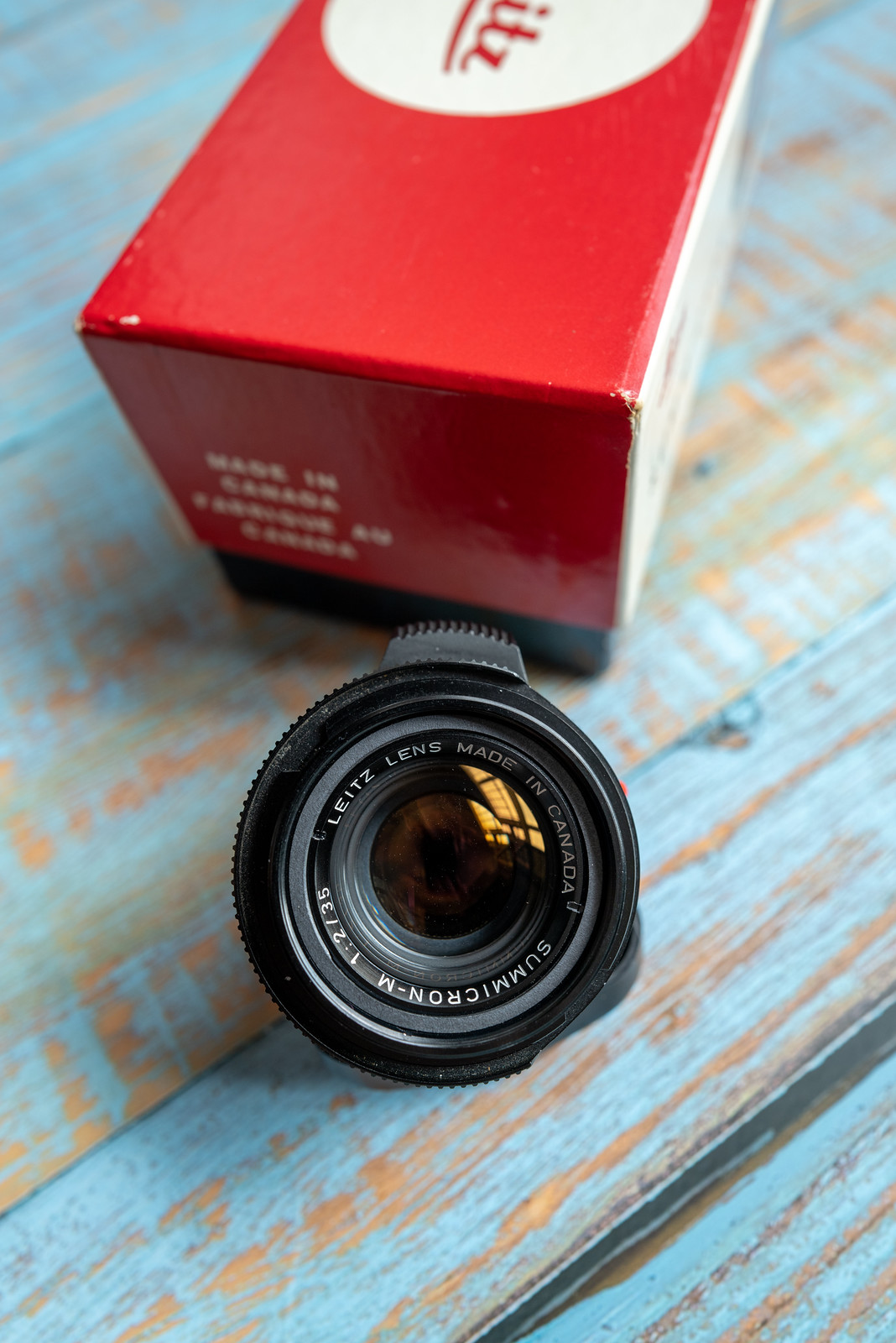
*The Tiger Paw version was only produced for 2 years, from 1979 to 1980, before Leica changed the focusing tab to the more standard version we see nowadays, hence the reason for some seeing it as a collectible among the King of Bokehs.
Leica themselves probably fumbled when they decided to declare the re-issue of the Summilux-M 35mm steel rim as the ‘True King of Bokeh’ given how cemented the lore of the Summicron “King of Bokeh” had become.
you know, ‘marketing’ ..

What’s in a name?
What is seldom mentioned is the name ‘Bokeh King’ was actually given by a SINGLE reviewer, and probably because resellers were eager to boost their sales numbers, the name simply stuck. If I recall right, that reviewer was Mike Johnston, who used the term ‘bokeh king’ in the caption of a magazine picture of the lens, and the rest, as we know, is history.


That is not to say the 35mm Summicron ƒ2 v4 is without its merits; especially to the many who swear by it and me inclusive, there are many lovely characteristics it possesses.
There are many reasons why the Leica 35mm Summicron ƒ2 v4 holds a unique place in the hearts of many even when it was likely never designed to be ‘special’ or ‘unique’.
The 35mm Summicron ƒ2 v4 lens

Instantly recognizable with its petite size and aperture ring design, the 35mm Summicron ƒ2 v4 is as small as they come for a full-frame Summicron lens. Markings are, as expected, reminiscent of Leica’s design DNA, and depending on whether it is a black or chrome version, we have yellow/white and red/white scale markings.
The 7 elements in 5 group optical design gave the lens its mandarin nickname of 七枚/七妹, a piece of Leica optics with its following even among collectors in China. The build, in my opinion, is decently good, never as good as, say, top-end Leica lenses like the M60 Summilux-M 35mm but robust enough to last decades easily.

Moreover, the consistently good performance across the full aperture range helped to cement its popularity among street photographers, who were more than happy to have the petite lens as part of their repertoire.

In fact, given Leica’s long and eventful history, the 35mm Summicron ƒ2 v4 ended up being in production in Canada and later Germany, with the made-in-Germany versions deemed more premium by some collectors because ‘Germany‘.
My own opinion would be I prefer a version made in the earlier years, as Walter Mandler was known to personally oversee the first few productions when based in Midland, Ontario, Canada.
*refer here for a list of lenses Walter Mandler designed.
The character of the Bokeh King


Colors from the 35mm Summicron ƒ2 v4 render slightly warm but not as saturated as modern versions of the 35mm lenses from Leica. Actually after looking at the more-towards-saturated rendering of modern lenses, the 35mm Summicron ƒ2 v4 comes as pleasant to me and will perform well either on film or digital.


The Leica 35mm Summicron ƒ2 v4 has a ‘fish-scale’ type of bokeh, slightly paintedly in nature. When choosing backgrounds while photographing wide open and close-up, I am sure some photographers may deliberately attempt to choose a background that might not be potentially distracting.


Unlike the ‘True King of Bokeh’, the Leica 35mm Summicron ƒ2 v4 renders sharp at the center even at wide open apertures, making this a truly everyday versatile lens. Though it will be good to note that corners aren’t hardly as great and this is to be expected.
Conclusion
Whether accidental or an over-zealous marketing move, the Leica 35mm Summicron ƒ2 v4 is a king in its own right. However, I reckon Leica, with newer releases along the never-ending slope of buy-buy-buy, will not be content to name it King. After all, they just crowned the 2022 re-issue of the Summilux-M 35mm Steel rim, the ‘True King of Bokeh.’
One can argue that the modern versions of the Leica Summicron-M 35mm are of better build and more corrected, and I wholeheartedly agree. However, as photographers or collectors, our mindsets do differ on a few different factors, for example, are we going to focus on the clinical perfection or the character of the lens?
At least for me, the Leica 35mm Summicron ƒ2 v4 is going to stay as the ‘King of Bokeh’ in the hearts of many Leica users, and this is one piece of optics that I will be glad to use along my digital or film Leica M bodies.

Thank you for reading.
Disclaimers:
- All product photos and samples here were photographed by me. I believe any reviewer with pride should produce their own product photos.
2. All images were shot with the Leica M10-R and my personal copy of the Leica 35mm Summicron ƒ2 v4
3. This review is not sponsored. There’s nothing to return this round as everything here is bought and paid for by me.
4. I do not do affiliate purchase links to keep myself neutral. I write as a passion and a hobby, and I appreciate that photography brands are kind enough to respect and work with me.
5. The best way to support me is to share the review, or you can always help support me by contributing to my fees to WordPress for the domain using the Paypal button at the bottom of the page.

 KeithWee | Photography
Hi Keith, I am glad to see you reviewing the bokeh king in this well written sharing. I do have one too and have always wondered about the story and how it performs.
LikeLike
Hi Daniel, thank you for the kind words. 🙂 I came across the KOB a few times but maybe.. finally kinda settled down enough to use it properly.
LikeLike
Excellent write up about this lens Keith! Hope to see you share a review on the new 50 Summilux soon.
LikeLiked by 1 person
Hi Carl, thank you for the kind words 🙂 let’s look forward to me having the opportunity for the 50 Lux haha.
LikeLike
It is 35 mm, also has a particularity, it has no optical distortion (unlike the aspherical version) Essential quality for film use and silver prints.
LikeLiked by 1 person
I’m a simpler user in that I like it , and it renders the way I like it haha
LikeLike
Nice review and lovely pictures. Thank you for sharing your thoughts.
LikeLiked by 1 person
Thank you for the kind words Stefan 🙂
LikeLike
Nice write up on this lens – thank you.
How would you compare the KOB (v4) to the 35mm Summicron v3?
I shoot M10Mono exclusively currently with the 35mm Summicron V3 and 35mm Summilux pre-asph v2 (titanium), but I have considered adding a 35Cron KOB, but not sure if this is just the GAS rabbit hole.
Would love to hear your thoughts?
Best, Mads
LikeLike
Hi! With a V3 Summicron and an pre-ASPH 35 my opinion is there is hardly a need for the KOB (unless you come across one at a too good to miss price) drawing wise the V3 is likely ‘sharper’ which I feel works well for the Monochrom and bokeh wise you have the preASPH 🙂
Just my 2 cents.
LikeLike
Thank you, Keith. That’s very helpful. You actually feel the V3 is “sharper”. I thought V4 would have slightly more contrast and sharpness than V3.
However, my aim is a timeless/classic BW look to my monochrom images, so it sounds like, I’m set with my current two lenses and no need to expand with a V4.
Which is your fave rendering-wise of the V3, V4 and pre-asph lux?
Best and thanks once again, Mads
LikeLiked by 1 person
Hi Mads,
Welcome, i had the V3 for a short while and hmm, i felt that it was sharper than the V4 but one detail that does bug me is sample variation. Nonetheless both lenses to me are great, only that the V4 prob has ‘better marketing’
My fav overall now is actually the preFLE , though I do not like the hood design I do really like the drawing and prefer it to the FLE.
Between the V3, V4 and pre-ASPH lux I’ll still prefer the V4 and more for its bokeh and overall look 🙂
LikeLike
Thank you, Keith. Really interesting. I have actually been considering the Summilux ASPH pre-FLE too. I had the FLE in the past, but now prefer more gentle rendering and contrast and hence more drawn to pre-asph Leica lenses on my M10Mono.
How do you find the size of the pre-FLE? Is it okay as an everyday lens or do you find it too big and cumbersome? I generally prefer small lenses on Leica M.
Best, Mads
LikeLike
Same here as to why I went from the FLE to the preFLE, and a surprise is, the FLE does have focus shift issues, just not as pronounced. I dislike the size of the hood of the preFLE and will probably go without the hood soon 😂 for days where I wish for a more compact setup , my KOB fits in nicely.
LikeLike
Hi again Keith, do you have the silver chrome or black KOB these days? And which of the two do your prefer? Best, Mads
LikeLike
Morning Mads 🙂 mine is the black KOB , the chrome one is very quite more costly and to me , not worth paying so much more for the same optics.
LikeLike
I have been eyeing both a black and a silver at “okay” prices given the overall high price and demand on this lens in the market.
Not sure if the silver is worth that bit extra in price for the nice built quality and rarity. Or if the black is actually nicer in use being lighter?
What to do 😊
LikeLiked by 1 person
Good write up Keith. But just so you know, the Germany KOB is not more expensive just because it says Germany. It’s because of a far superior build quality. The Canadian version has a plastic inner part that breaks over time. It makes the lens not usable, and it’s long and difficult to have it repaired. The German version fixed it by making this mentioned part in metal, and therefore is more robust and long lasting. This is why it is sold for more money. Image wise, there’s no reason to prefer the Canadian over the German or vice versa. They render identical. Have a wonderful day.
LikeLiked by 1 person
hi! Thank you for sharing this nugget of knowledge. I have heard of this difference but never got Leica to confirm it (haha, as if they would) and glad to hear this from you too, and I really guess there is some truth in this. Have a great day ahead.
LikeLike
Thanks for the review! How does it compare to the more budget friendly Ultron? To me, there seems to be some characteristics that look very similar.
LikeLike
Hi, thank you for popping by. The Ultron is a nice lens which (I’m not sure why) is increasingly harder to find nowadays too. Comparing both the Ultron is more modern output wise and build wise I guess not likely to last as long as the KOB. Nonetheless it is still a nice lens to go for.
LikeLike