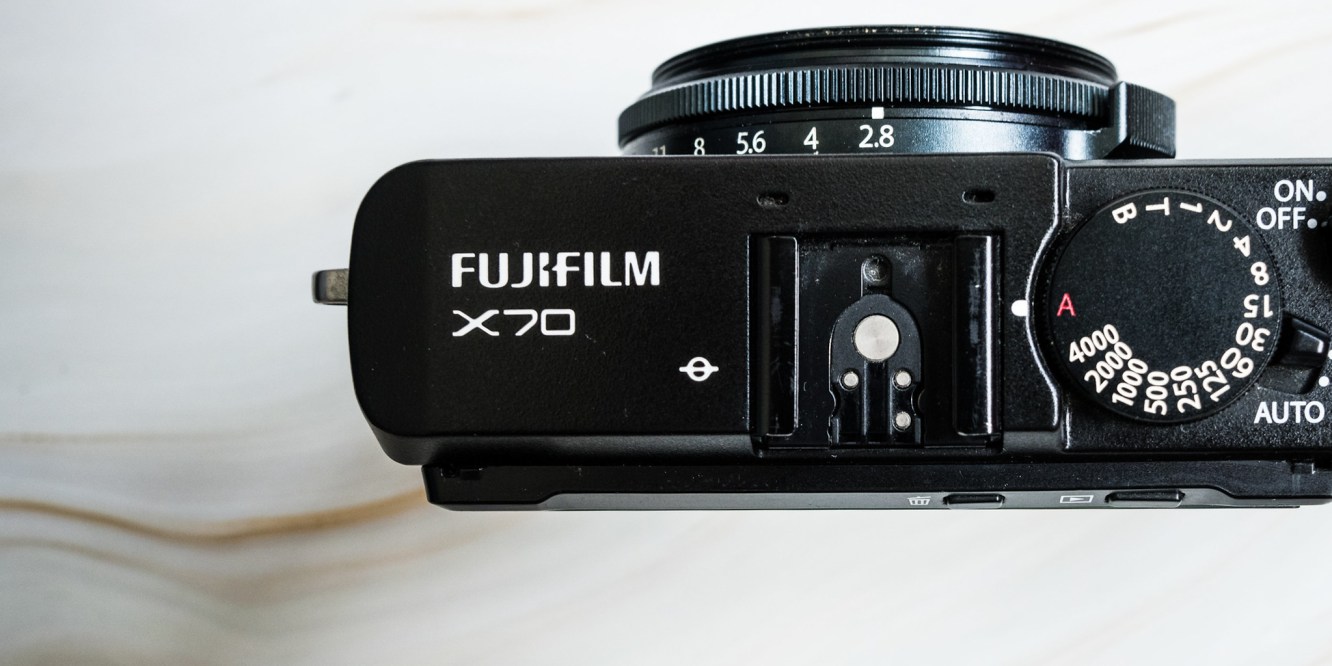
disclaimer: I started with the intent on covering the Fujifilm X70 camera, but as the article grew, I guess it also became an ode to the ‘older’ Fujifilm that I started my photography pre-Leica era with.
Introduction
Every once in a while, a camera reappears in one’s life not because it is the newest, fastest or most hyped, but because it reminds us that good design has a way of quietly aging well.
The Fujifilm X70 is one such camera.

Released back in 2016, the Fujifilm X70 arrived with a 16.3 megapixel APS-C X-Trans CMOS II sensor, a fixed 18.5mm ƒ2.8 lens giving a 28mm equivalent field of view, a leaf shutter, and perhaps most importantly, a tilting touchscreen in a body weighing only about 340g with battery and card. In many ways, it was a rather audacious camera for its time.

In 2016 where the main alternatives were the Leica X-series, Ricoh GR II, Fujifilm X100T and the more specialised Sigma dp Quattro series, the Fujifilm X70 was a winner in functional design.
And here in 2026, after Fujifilm has gone on to produce immensely capable cameras such as the X100VI and multiple 40MP bodies (I lost count), I find it fascinating that the company has still not made a true successor to the X70. The X100 line has continued to evolve over six generations, while the X70 remains frozen in time as a singular idea Fujifilm got very right.

This article is not about romanticising old gear for the sake of it.
Rather, it is about revisiting the Fujifilm X70 in 2026 and asking a very simple question: why does this decade-old compact still feel so relevant, and why has Fujifilm still not given us an X70 Mark II, X80 or whatever they may wish to call it?
If your are keen on my other reviews on fixed lens cameras:
1. Leica Q3 43 Review – The Peerless
2. Leica Q3 in-depth review – Five critical improvements to the Q-system.
3. Fujifilm X100VI review – Embracing its charms and Considering its drawbacks

A question I found myself asking was: “Did Fujifilm accidentally make one of its most well designed compact cameras too early?”
tl:dr
The Fujifilm X70 remains, even in 2026, one of the best compact cameras Fujifilm has ever designed, in fact still one of the best fixed lens cameras one can find with no direct competitors.

It is true that the autofocus is dated, no built-in viewfinder, battery life is merely acceptable, and the 16MP sensor obviously does not compete on paper with modern high-resolution offerings. Yet the X70 still offers something many newer cameras do not: a truly compact APS-C shooting experience with tactile controls, a 28mm equivalent lens, a leaf shutter, and a tilting touchscreen that changes how one photographs on the street and in daily life.
I might be wrong, but versus the newer Fujifilm cameras (I am also using the Fujifilm X-M5 now), I do not really feel that Fujifilm’s autofocus capabilities have improved so much over ten years to render the X70 ‘that’ antiquated.

In my humblest opinion, Fujifilm’s greatest failure here is not that the X70 grew old.
It is that Fujifilm never followed through on this design.


Technicalities
I am obviously not going to spend the bulk of writing reproducing specification sheets when that can easily be found elsewhere, so let us keep this to what matters.
The Fujifilm X70 came with:
- a 16.3MP APS-C X-Trans CMOS II sensor
- an 18.5mm ƒ2.8 fixed lens, or 28mm equivalent in full-frame terms
- a 3-inch 1.04 million-dot tilting touchscreen
- a mechanical shutter to 1/4000s and electronic shutter to 1/32000s
- a leaf shutter design
- a weight of approximately 340g including battery and card
- CIPA-rated battery life of about 330 shots with the now discontinued NP-95 battery.
- a built-in flash of GN5.5 (ISO100), great for fill-in closer range shots.

By 2026 standards, one can argue these are modest specifications, but think for a bit, is there another 28mm equivalent camera that has a built in flash, tilt-screen with options for a wide-converter to 21mm equivalent in 2026?
the ‘old’ Fujifilm did not care about winning any specs battle, against Sony, Canon or Nikon the ‘old’ Fujifilm simply couldn’t. But boy, it easily won with their sheer creativity and “customer at the center” kaizen spirit focusing on the photographic experience some brands still cannot figure out in 2026.
But the Fujifilm X70 was never about winning a specification battle. It was about delivering a certain kind of photographic experience in a form factor Fujifilm still has not recreated in a decade.
Five reasons the Fujifilm X70 still feels special in 2026
1. The design remains one of Fujifilm’s most elegant compact solutions
The X70 is small in a way many cameras today claim to be, but are not.
It is simply just genuinely compact.

That matters, because an excellent camera design makes the user yearn to bring it out to explore.
There is a different mindset when carrying a camera that disappears into a small pouch or jacket pocket without demanding a dedicated bag.


This is perhaps the point Fujifilm missed.
The X100 series became more refined, more prestigious, and more desirable, but it was never quite the same category of carry as the X70. For all the improvements the X100VI brought to the table, I still very much preferred the 2010 Fujifilm X100 in terms of output too. (my writeup is here)
2. The 28mm equivalent focal length gives it a distinct identity
The X100 line owns the 35mm equivalent (the Sony RX1R III is a real contender but that’s for another day)
The Ricoh GR line has long owned the high-performance pocketable APS-C compact discussion.
But the X70 sits in a lovely place between those identities, pairing Fujifilm colour science and physical controls with a 28mm equivalent lens that invites context into the frame. The lens was described at launch as edge-to-edge sharp and fantastic for street photography, and I think that still holds up conceptually today.


A 28mm equivalent lens is not for every photographer, but for environmental portraits, travel, street scenes, food, family life and urban documentation, it has an honesty to it. It asks the photographer to move, to engage, to step closer, like what the Leica Q series now coming to its 4th iteration soon has very successfully implemented.
And perhaps that is part of the X70’s charm. It is a camera that encourages participation.
3. The tilt touchscreen was, and still is, the magic
One of the cleverest things Fujifilm did with the X70 was to not force it to imitate the X100 completely.

There is no built-in viewfinder but Fujifilm followed up with the VF-X21, a well-built optical viewfinder with 21mm and 28mm frame-lines. While the lack of an EVF might be a deal-breaker for some, what Fujifilm did instead was to build around the touchscreen and tilt mechanism in a way that changed the shooting experience.
A tilt screen only came to the X100 series in 2020 through the X100V, while the X70 had it since 2016 while the 2026 Ricoh GR IV still does not have a tilt-screen.
I think this was prophetic.

In 2026, low-angle waist-level shooting, discreet framing, and fluid touch interaction feel entirely normal. Yet the X70 did this in 2016, and did so in a way that felt purposeful rather than gimmicky. Fujifilm’s own specs confirm the X70 carried a 3-inch 1040k-dot tilting touchscreen, which at the time was a meaningful step in their design evolution.

4. The leaf shutter makes it quieter and more refined than it gets credit for
Leaf shutters are one of those features photographers do not always mention first, but deeply appreciate in use.
The X70 inherited one of the X100 family’s most elegant strengths here: quiet, discreet operation with the practical benefits of a leaf shutter. While professionals love it for flash sync conveniences, the key was that to most photographers, the leaf shutter was cherished for its strength in photographing sensitive moments.


For street photography, family documentation, temples, cultural spaces, and everyday candid moments, that ‘polite softness’ matters.
I mean, even in 2026, I am still traumatised by how the shutter slap of my-then Sony A7-R waking my kid up from sleep.
It makes the camera feel polite, and most key, a camera no subject bothers to care about.
5. It represents a branch of Fujifilm design DNA that was abandoned too soon
When I reviewed the Fujifilm X100VI, one thing I noted was how the X100 series has become the crystallisation of Fujifilm’s design DNA over years of refinement. It is indeed a fine camera, but somehow, does not make me want to use it as much as I should in an era now where my other choices are the Leica Q3, Ricoh GR IV, Sony RX1R III and their respective variants.

But the X70 was another branch of that same DNA. A wild one yes, but undoubtly an effective one.
It was the more understated sibling. Less iconic perhaps, but in some ways more radical. It offered Fujifilm handling, APS-C image quality, true compactness, and a 28mm perspective in a package that still feels modern in intent.

This is why the absence of a successor is so puzzling.
So why has Fujifilm not made a successor?
That, to me, is the real story.
If you are waiting for Fujifilm to make an X70 successor, that is where things get interesting, because while Fujifilm has been busy doing Fujifilm things exploring different product concepts and lines, Ricoh has simply buckled down and focused on pushing in this one exact pocketable street-camera space.
And I think that is precisely it.
Fujifilm chose to consolidate its compact prestige around the X100 series. The X100 series became not merely a camera, but a cultural object of desire. Demand exploded, especially in the social media era, and Fujifilm had little commercial incentive to create another APS-C fixed-lens compact that might sit too close to it. I easily recount the frustration many had dealing with scalpers and non-existent stock for months.
While Fujifilm might have been glad to see the X100VI sold out for months, the trade-off in good-will and how it ended up pushing some photographers to the Ricoh GR or Leica Q is not a loss money can easily fix.
But from a photographic ecosystem perspective, the Fujifilm X70 deserved continuity instead of being hidden and buried under time.

An imaginary X70 successor in 2026 could have been extraordinary:
Imagine in the same body a modern 26MP sensor/processor, improved autofocus, newer film simulations, USB-C, better battery life, perhaps weather resistance, while keeping the same core philosophy of compactness, 28mm equivalent view, leaf shutter, and tilt screen and a built-in flash.
That would not have cannibalised the Fujifilm X100 series.
It would have complemented it, and I am sure Fujifilm will be selling more of these than the Fujifilm X-Half and Fujifilm Instax Mini Evo Cinema put together by many times. Remember that both Leica and Ricoh now sell 28mm and 40/43mm variants of the same camera, in fact Ricoh simply replaced its ND filter with a ‘pro-mist’ similar filter and voila, a new model!
Final thoughts
The Fujifilm X70 in 2026 is not merely a good old camera. To start, it does not have IBIS too, deemed for some weird reasons by some spec-lovers to be a necessity – and for good measure, Fujifilm’s newest X-T30III and X-M5 cameras don’t feature IBIS too.

It is a reminder.
A reminder that excellent camera design is not only about megapixels, IBIS, subject detection, or social media hype. Sometimes it is about getting the size, focal length, controls and shooting experience so right that the camera remains desirable a decade later.

Let us not forget what made Fujifilm thrive in the 1st place: an enviable spirit of kaizen focused on improving the photography experience.
The X70 is one of Fujifilm’s best compact ideas.
And in my view, Fujifilm’s strangest omission is not that they moved forward.
It is that they never came back to finish this chapter, and maybe ended up started writing too many books at the same time.
If you already own one, I think there is every reason to keep it, provided it is still working well. If you are considering one in 2026, go in with open eyes: you are buying older tech, but also one of Fujifilm’s most coherent compact designs.

The Fujifilm X70 may be a camera from 2016.
But the idea behind it?
That idea still feels like it belongs in 2026.
Thank you for reading.
Disclaimers:
- All product photos and samples here were photographed by me. I believe any reviewer with pride should produce their own photos.
2. All images were shot with my personal set of the Fujifilm X70
3. I did not receive any payment in any form for this article.
4. I write as a passion and a hobby, and I appreciate that photography brands are kind enough to respect and work with me.
5. The best way to support me is to share the review, or you can always help support me by contributing to my fees to WordPress for the domain using the Paypal button at the bottom of the page.

 KeithWee | Photography
hi Keith, I have been following your reviews for years and this is one of the most heartfelt sharing about how Fujifilm has changed over time.
LikeLike
Hi there, thank you 🙂 Fujifilm will always have a special place in my heart.
LikeLike
some might say Fujifilm has grown with their new creative instax cameras but so little has changed in their X-series. Thank you for this bro.
LikeLike
Thank you 🙏
LikeLike
I think your pictures really speak for themselves. I think you really leveraged the 28mm equivalent focal length quite well. It makes me want to pick up a Ricoh GR IV, which is what I would get these days, for the same purpose, if money wasn’t a problem. Because you are right, Fuji abandoned that market, and Ricoh owns it now. That is just how it is. But it doesn’t mean that if you already have an X70, or if the Ricoh was too expensive, that the X70 wouldn’t be able to do the job well. I think your pictures in this article have just proven that.
You can also see in some of the night shots, how it renders a glow around highlights. Maybe not something that a “techincally perfect” lens is allowed to do in this way, but it really adds to the athmosphere. The Ricoh does the same thing by the way, even though it’s lens is supposed to be even better in some ways.
Anyway, nice shots, Keith!
LikeLike
Hi Djulina, thank you for the kind words 🙂 yes, glad you pointed too the the lens is not too clinical and in a way lends to the character in the output too.
Of course there will always be newer more modern options for some cases but this doesn’t mean that the original older versions were too lacking either.
Have a great day ahead
LikeLike